
Singapore in January: Weather, Chinese New Year and Tips
Discover Singapore in January: weather, Chinese New Year and practical advice for making the most of your stay, even during rainy spells.
Fort Canning Park is easiest to explore by choosing a theme: gardens that evoke Singapore’s earliest periods, or the military and colonial traces found on the hill. This approach lets you enjoy the heritage and nature without turning the walk into a succession of climbs, steps and photographs. The spiral staircase, which is particularly popular for photography, can remain an optional stop.
The park is open continuously, while the galleries and heritage attractions have their own opening hours. For a first visit, plan a walk suited to your fitness level, allow time to read the information panels and check access arrangements before setting out. Opening hours may change: check the NParks information or the details provided by the organisation managing the attraction on the day of your visit.
In brief
Tip: set up a Singapore eSIM before departure so your data works on arrival.
The hill brings together several periods of Singapore’s history. Accounts refer to a Malay past before the British presence, followed by colonial administration, military uses and the transformation of the area into a public park. The panels and heritage sites help you follow these changes, provided you do not rush through the site.
To organise your visit, start by deciding what interests you most. The historic gardens suit visitors who want to observe the landscaping and understand references to the ancient past; the buildings and military remains are more suited to those interested in the colonial period and the Second World War.
| Point of reference | What to know | Visiting advice |
|---|---|---|
| Park | NParks describes Fort Canning Park as a 22-hectare park in 2026. | Check the map before choosing your entrance and exit. |
| MRT access | Nearby stations include Fort Canning, Dhoby Ghaut and Clarke Quay. | The most convenient station depends on the slope and the stops you choose. |
| Terrain | Routes include slopes, steps and outdoor paths. | Bring suitable shoes and water. |
| Galleries | Their opening hours differ from those of the park. | Check the hours with NParks before travelling. |
According to the information consulted in 2026, NParks says that the park is accessible 24 hours a day, but this does not mean that the indoor spaces are open continuously. For Fort Canning Heritage Gallery, the opening hours published by NParks in 2026 are 10am to 6pm, with a maintenance closure on the last Monday of each month; Spice Gallery is advertised as open from 7am to 7pm. As these hours may change, check them with NParks before your visit.
A short walk can focus on a few gardens or on the historic points close to your entrance. Adding a gallery and a longer crossing requires more time, particularly if you stop to read the explanations or rest. Durations mentioned in guides do not always include waiting, heat or detours caused by temporary closures.
The park map is more useful than an itinerary based entirely on photographs. It helps you identify changes in level, connections and exits before tackling a slope. If you need to limit the number of steps or the distance, choose a specific area and confirm with NParks that the relevant path meets your needs.
Fort Canning also lends itself to a self-guided visit: the panels put each place into context and allow you to move from one period to another without following a single narrative. To place this walk among the city’s other green spaces, also see our page on green spaces and nature in Singapore. The best route is the one that leaves time to look around, not just to keep moving.
Fort Canning’s gardens are interpretive spaces: they evoke different periods and traditions, but should not be confused with ancient remains that have survived intact. This distinction matters when understanding the site. A garden can recreate a historical atmosphere or idea without being material evidence of an original palace or layout.
Sang Nila Utama Garden is a good starting point for this interpretation. Its split gates, planting and vistas draw on references from Southeast Asia and the story associated with Prince Sang Nila Utama. According to the tradition recorded in the Malay Annals, he is said to have named Singapura after seeing an animal he took to be a lion; this is a historical and legendary tradition, not an established zoological observation.
On site, take time to observe the relationship between the gates, paths and plants. Details are easier to notice if you step away from the main route without obstructing other visitors. Botanical labels can also direct your attention to the scents, leaves or uses of the species on display: a few precise observations will enrich the walk more than a series of similar photographs.
Artisan’s Garden offers another perspective. Its interest lies particularly in the archaeology and human activities associated with the hill. An archaeological site does not necessarily contain spectacular ruins; the panels help explain what was excavated, what the remains can reveal and why an area used for work or habitation deserves attention.
Pancur Larangan adds an evocation of an ancient bathing place to the route. The garden and its water features should not be interpreted as an invitation to swim: the instructions displayed on site take precedence. For a balanced visit, choose two or three stops rather than forcing yourself to visit every garden on the hill.
Spice Gallery may appeal to visitors who want to connect plants with the history of trade and food. The spice garden is associated with an attempt to grow valuable species on the hill at the beginning of the colonial period. The reconstruction allows you to observe these plants, while the explanations place the crops in the context of regional trade; it is not a large botanical garden comparable with a specialist collection.
Fort Canning Heritage Gallery is better suited to visitors who want an overview of the site’s transformations before walking around. It can also provide an indoor break in the middle of the walk when the heat makes a rest welcome. Check its location on the map and its opening hours: general access to the park does not guarantee access to the gallery.
These gardens make most sense when approached as heritage interpretations rather than settings detached from their context. By paying attention to the panels, planting and archaeological clues, the walk connects Singapore’s nature with its history.
The hill also played a military role. The remains associated with the historic fort and the colonial-era buildings recall the strategic importance of this elevation in the heart of Singapore. The route includes Fort Canning Centre, Fort Gate, the former powder magazine and a cannon, as well as reproductions of communications equipment.
The visible features do not all have the same status. Some are preserved or restored structures, while others have been adapted or reproduced to explain how the site was used. Reading the panels helps you avoid mistaking a reconstruction for an original remnant and shows how the hill changed after its fortification.
NParks describes a colonial trail of approximately two kilometres and estimates the walk at 45 minutes in the information consulted in 2026. This duration refers to the stated walking time, not to a complete visit with breaks, photographs and reading. Moderate slopes and historical stops may extend the outing; adapt the route to your pace.
Battlebox is located in an underground command bunker linked to the final days of the British defence of Singapore. On 15 February 1942, British forces surrendered to the Japanese army. This date marked a major turning point in the Second World War in Southeast Asia and explains the bunker’s historical importance, without reducing the entire history of the hill to this episode.
A visit to Battlebox is different from a simple outdoor walk: it focuses on command decisions and takes place in spaces connected with this history. Some rooms are presented as military workplaces, including those dedicated to operations and communications. The interpretation material helps explain the decisions and constraints of the period; the site is therefore more than an underground setting.
Access to Battlebox, its prices, time slots and booking arrangements may change. Check directly with the organisation that manages it before planning your visit, especially if you want to join a guided experience at a fixed time. Entry to the park does not automatically provide access to heritage spaces operated separately.
The hill also contains a colonial Christian cemetery and Malay memorial sites. Keramat Iskandar Shah is a shrine associated with the tradition concerning the last ruler of ancient Singapore; it is a place of worship and should be treated respectfully, not as a simple tourist backdrop. The colonial cemetery, meanwhile, allows visitors to explore the lives of the early British administration from a more everyday perspective through its plaques and trees.
If you would like to continue this historical exploration indoors, the National Museum of Singapore provides another setting in which to explore the country’s past. Fort Canning offers places and landscapes to walk through; the museum allows more time for collections and historical accounts. Combining the two works best if you do not try to rush through everything.
Fort Canning’s spiral staircase has become a highly sought-after photography spot. Its appeal lies in the geometry of the structure and the perspective created by the trees and levels of the park. It can attract a queue of visitors, but it does not sum up either the history or the gardens of the hill.
For a more pleasant photograph, first observe the flow of people and wait until the passage is clear. Avoid occupying the steps for too long or obstructing people going up and down. During busy periods, consider whether the wait is worthwhile: a nearby garden may provide a more rewarding break than several similar shots.
Light changes the appearance of the site. An early-morning visit is generally more comfortable for walking in Singapore’s heat and humidity, and the paths are often quieter before the day gets busier. Shaded areas remain pleasant, but they do not remove the climbs or the heat in exposed spaces. For more information about local conditions, see our guide to Singapore’s climate and seasons.
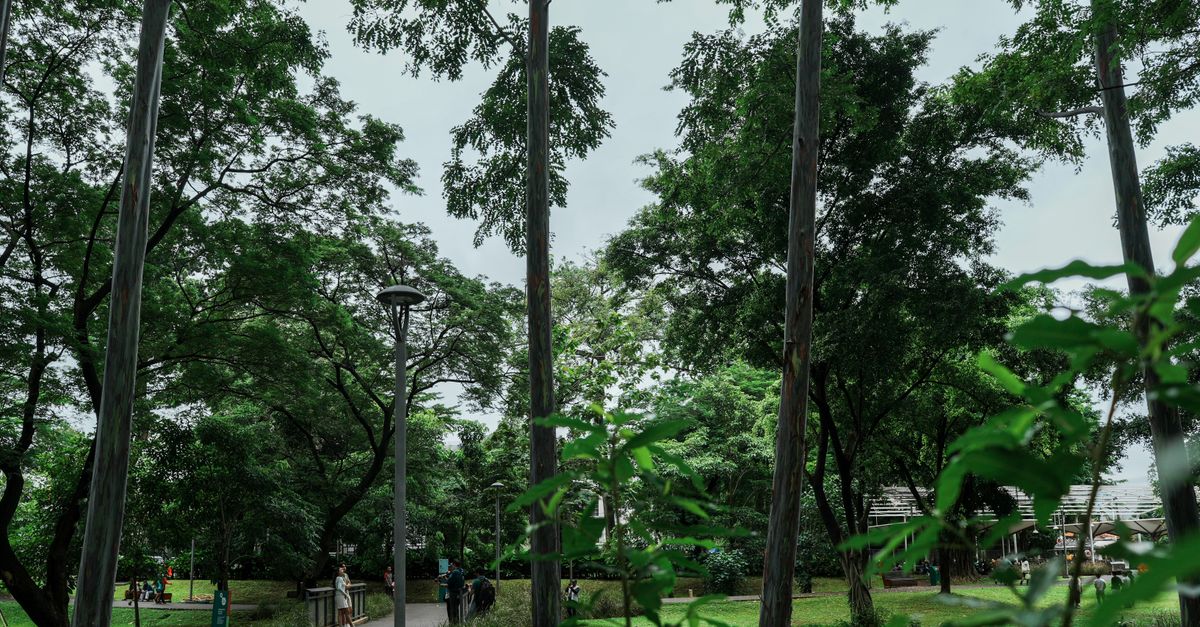
The park is also a natural space in the middle of the urban centre. Mature trees, planting and themed gardens create different atmospheres from one slope to another. Notice changes in vegetation and the labels rather than trying to identify every plant: this gives the walk a botanical dimension without claiming to replace a specialist visit.
Views of the surrounding area may appear from some open points, but the outlook varies according to the location and conditions. Trees and buildings sometimes limit the field of vision; it is better to regard the landscape as a bonus than as a promise of a completely open viewpoint. Also take account of the signs and any access restrictions.
Singapore’s tropical weather calls for a few simple precautions. Bring water, wear shoes with good grip and slow down on steps when they are wet. During a thunderstorm, do not remain under a tree: stop the walk and seek an authorised indoor shelter. A successful visit depends as much on choosing the right time as on the list of places to see.
People using a pushchair or wheelchair, or those wishing to avoid steps, should check the precise connections on the current map and with NParks. An accessible entrance does not guarantee that all the gardens are connected by a step-free route. It is safer to choose an area whose route has been confirmed than to discover a difficulty after crossing the hill.
The staircase photograph may be a memorable part of the visit, but it should not dictate its pace. Fort Canning is richer when you alternate observation, walking and breaks, giving nature as much space as the scenery.
Fort Canning, Dhoby Ghaut and Clarke Quay stations serve the edges of the park. Your choice depends on your route: Fort Canning station allows you to approach the northern slope, while the others may be more convenient when arriving from nearby districts. Check your transport route on the day, as the exits and pedestrian paths do not all lead to the same point on the hill. Our Singapore MRT guide can help you plan the journey.
The park can form part of a longer walk through the city centre. Clarke Quay and the Singapore River banks allow you to continue south; the Civic District and its museums lie in the other direction. For a day focused on shopping, Orchard Road is another urban stop, but you will need to allow for travel and tiredness after the climb.
A sensible itinerary starts with one priority. For example, garden enthusiasts can focus on Sang Nila Utama Garden, Artisan’s Garden and, if time allows, Pancur Larangan. Visitors interested in military history can follow the colonial trail panels and decide in advance whether they want to set aside time for Battlebox.
Whichever option you choose, leave room for breaks. The walking time given for a route does not necessarily include stops, guided visits or waiting at a photography spot. A visit to a few gardens may be enough; adding a gallery and a route across the other side of the hill significantly changes the duration and effort required.
There is no reason to make every staircase a compulsory stop. When visiting as a family, check regularly whether everyone wants to continue and plan an exit towards a neighbourhood where you can find somewhere to eat. Visitors drawn to history may prefer a gallery to a photography detour; those mainly looking for a green walk may leave the park after a few gardens.
Events held at Fort Canning Green can change the atmosphere and temporarily affect access. Concerts, performances and other events depend on a changing programme: check with the relevant organiser before building your day around a show. Do not assume that opening hours, tickets or access rules remain identical from one season to the next.
To put Fort Canning in the context of city life, our page on Singapore’s neighbourhoods lets you compare the areas around the hill. You can also plan a stop at Orchard Road with this guide to shopping on Orchard Road. Connecting neighbourhoods according to your interests makes the walk a coherent part of your stay rather than an isolated excursion.
Before setting out, check the map, the opening hours of indoor spaces and any closures. Bring water and choose a route compatible with the weather and your walking ability. This preparation leaves more room for what makes Fort Canning special: a central hill where heritage, gardens and urban life meet.
Access to the park is free according to information published by NParks. Some galleries, tours or heritage attractions may have separate access conditions; check the arrangements with the relevant organisation.
The duration depends on your route. A selection of gardens takes less time than a visit combining a historical walk, gallery and Battlebox. Walking times do not always include breaks, reading or waiting.
The staircase is in the park and is a well-known photography spot. Check the current map or the signs on site to reach it from your entrance, as the route depends on which slope you choose.
It will particularly interest visitors who want to understand the fall of Singapore and the military history of the Second World War. As its opening hours, prices and booking arrangements may change, check the information directly with the organisation that manages it.
The park includes slopes and steps, and not all connections between the gardens are necessarily step-free. Check the current map and ask NParks for advice when choosing a route suited to your needs.

Updated on 05/11/2026
Scroll to see more articles →