Singapore Laws: Chewing Gum, Fines and Banned Items
Discover the main Singapore laws on chewing gum, fines, vaping, drugs, medicines and daily rules to avoid penalties during your stay.
The best time to visit Singapore is generally between February and early March, when rainfall decreases. The city-state remains accessible all year round: temperatures change little, humidity stays high and no month guarantees a rain-free stay.
To decide when to visit Singapore, it is therefore better to compare rainfall patterns than to look for a cool season. A trip focused on museums, historic neighbourhoods and local food depends less on the calendar than an itinerary centred on gardens, beaches and walks.
February is a reliable choice for a first visit, while the end of the year requires more flexibility. April and May can work well, but the heat and thunderstorms make long outings more tiring.
Climate averages help you compare months, but they cannot predict the weather during your holiday. For a departure in 2026, local conditions and the events calendar should be checked separately: a period that is usually less humid may still experience a very wet spell, and a major event may temporarily affect visitor numbers.
In brief
February is the best starting point when choosing your dates if you want to walk between neighbourhoods and spend time outdoors. It corresponds to the rainfall low in the Changi station averages published by the Meteorological Service Singapore for 1991–2020.
March remains interesting, but thunderstorms gradually become more frequent. April can also suit an urban visit, without offering February’s same rainfall advantage: presenting it as a uniformly dry period would be misleading.
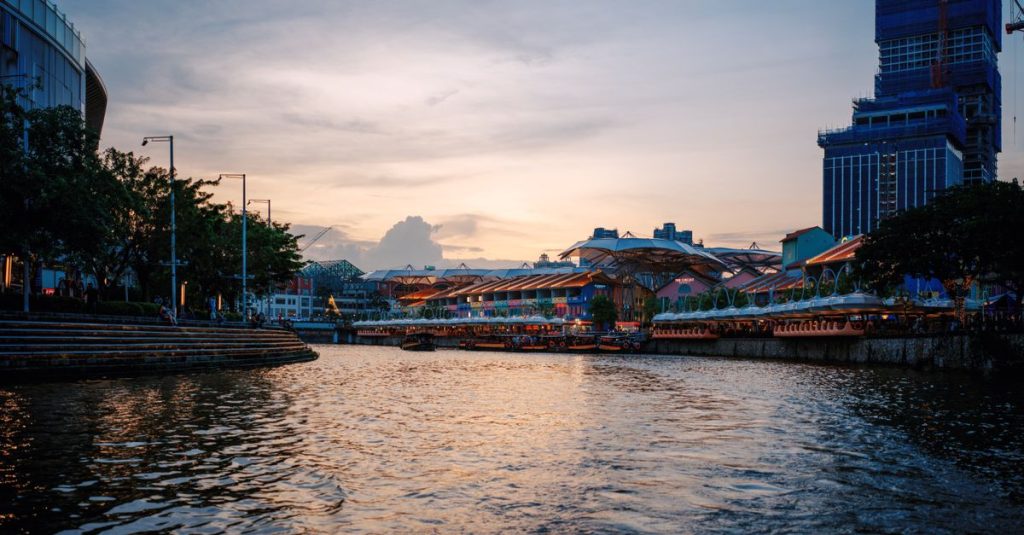
To connect Chinatown, the quays and Marina Bay, a lower frequency of showers makes getting around easier. It does not remove the fatigue caused by humid air, so plan covered breaks rather than a succession of long walks.
A cultural trip is better able to cope with changing weather. Museums, galleries and meals in covered food spaces make it possible to change your plans without losing a day.
November, December and January are generally wetter. This does not mean you should rule them out, but outdoor excursions are best kept flexible, particularly when several days are disrupted by the monsoon.
The right compromise therefore depends on how much space you give to outdoor activities, rather than on a difference in temperature. Our guide to Singapore’s climate and seasons helps explain this tropical pattern.
The following figures are the 1991–2020 Changi climate normals published by the Meteorological Service Singapore. Minimum and maximum temperatures are monthly averages: they are neither records nor forecasts for your trip.
| Month | Average minimum | Average maximum | Average rainfall |
|---|---|---|---|
| January | 24.3 °C | 30.6 °C | 221.6 mm |
| February | 24.6 °C | 31.5 °C | 105.1 mm |
| March | 24.9 °C | 32.2 °C | 151.7 mm |
| April | 25.3 °C | 32.4 °C | 164.3 mm |
| May | 25.7 °C | 32.3 °C | 164.3 mm |
| June | 25.7 °C | 31.9 °C | 135.3 mm |
| July | 25.4 °C | 31.4 °C | 146.6 mm |
| August | 25.3 °C | 31.4 °C | 146.9 mm |
| September | 25.2 °C | 31.6 °C | 124.9 mm |
| October | 25.0 °C | 31.8 °C | 168.3 mm |
| November | 24.6 °C | 31.2 °C | 252.3 mm |
| December | 24.3 °C | 30.5 °C | 331.9 mm |
Singapore weather in January remains influenced by the wet phase of the Northeast Monsoon. Prolonged spells can make walks difficult, even though temperatures are relatively lower.
February brings a clear fall in rainfall totals. March becomes hotter, while April records the highest average maximum in the table: physical effort outdoors then requires more breaks.
May combines hot nights with heavy-feeling days. June marks the start of the Southwest Monsoon, without the thermal change associated with a European change of season.
Singapore weather in July allows for normal sightseeing, provided you accept showers and possible morning thunderstorms. August has a similar profile: there is no need to rule out these months for an urban stay.
September has relatively moderate rainfall totals in this series. Rainfall increases in October, before a marked intensification in November and December.
Temperatures in Singapore vary less than rainfall: an end-of-year suitcase should still be tropical. Monthly totals do not, however, indicate how long each spell will last or how it will be distributed during your stay.
Singapore’s climate is equatorial, hot and humid, with no true dry season. Its proximity to the equator explains the limited annual temperature variation; changes in wind determine the rainfall pattern more than anything else.
The expression rainy season in Singapore mainly refers to the increase seen at the end of the year. It does not mean that the other months are dry, nor that December showers are always limited to a short spell.
The Northeast Monsoon has a wet phase, particularly noticeable in December and early January, followed by a generally drier phase. Monsoon surges can bring prolonged rain, so it is better not to organise your entire stay around fixed outdoor time slots.
From June to September, the Southwest Monsoon can be accompanied by Sumatra squalls. These storm lines sometimes bring heavy rain and gusts from the morning onwards, so setting off early is not an absolute guarantee.
The inter-monsoon periods favour light winds and local thunderstorms, particularly in the afternoon. When you hear thunder, stop exposed activities and go into an enclosed building rather than sheltering under a tree.
Rain can also affect one neighbourhood while temporarily sparing another. A recent local forecast is more useful than a single daily icon when deciding whether to go for a walk or take a trip out to sea.
For green spaces, choose mornings when the forecast allows. In the Botanic Gardens and the outdoor areas of Gardens by the Bay, shade improves comfort without removing the humidity.
February and early March generally offer favourable conditions for this type of itinerary. During stormier months, keep an accessible indoor alternative and avoid chaining together outdoor activities that cannot be changed.
Sea temperatures in Singapore remain warm all year round. For the beaches of Sentosa and trips to the southern islands, the main considerations are instead the sky conditions, thunderstorms and sea conditions.
Warm water does not make swimming safe during an electrical storm. Follow local instructions and check the conditions for crossings or water activities with the operator.
Our selection of visits and excursions in Singapore makes it possible to alternate outdoor discoveries with sheltered places.
Chinese New Year, the year-end celebrations and the Grand Prix can significantly affect demand on certain dates. For the Grand Prix, check the calendar with Singapore GP or Formula 1: do not assume that it always takes place in the same month.
May–June and September–October therefore guarantee neither quiet conditions nor cheaper accommodation. Compare actual prices and cancellation terms, with the help of our page on the budget required in Singapore.
The events calendar matters as much as the weather when choosing a hotel, particularly around areas directly affected by events.
Build each day around an area rather than around long walks across the city. Combining a walk, a museum and a covered meal in the same neighbourhood makes it easier to adjust your plans when a shower arrives.
The MRT and covered walkways reduce exposure, but not every route is covered. Consult our guide to transport and getting around Singapore to identify options suited to your accommodation.
Pack breathable clothing, shoes that can cope with humidity, sun protection and a compact umbrella. An extra light layer can be useful in heavily air-conditioned interiors.
Drink regularly and reduce physical effort during the hottest parts of the day. On arrival, travel fatigue can make long walks more tiring; the guide to local time and the time difference will help you prepare your routine.
Before an excursion, check the forecasts from the Meteorological Service Singapore. In the event of regional haze, also check air-quality information from the National Environment Agency: these episodes are irregular and cannot be inferred from a monthly average.
Plan an adaptable itinerary, then make decisions according to the day’s conditions. This is particularly useful for water activities, exposed walks and sports.
February is generally the best compromise for limiting rainfall. Early March is also suitable, without any guarantee of entirely dry days.
No, but December requires more flexibility because of the rain. An itinerary combining museums, restaurants and walks that can be changed remains suitable.
In the 1991–2020 Changi normals published by the Meteorological Service Singapore, April has the highest average maximum, at 32.4 °C. May is the hottest when considering the average over the entire day.
No. They describe the climate over a long period, not conditions on specific dates. Check the forecasts and alerts from the Meteorological Service Singapore before heading out.
Updated on 13/10/2026
Scroll to see more articles →