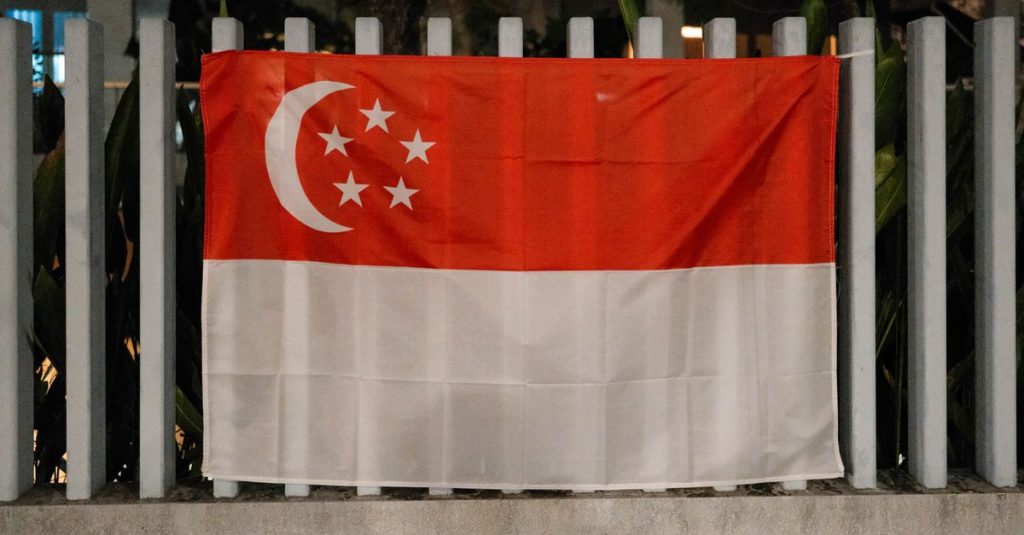
Singapore Laws: Chewing Gum, Fines and Banned Items
Discover the main Singapore laws on chewing gum, fines, vaping, drugs, medicines and daily rules to avoid penalties during your stay.
Singapore observes Singapore Standard Time (SGT, UTC+8) all year round, with no summer/winter time change. The city-state is therefore 6 hours ahead of metropolitan France during French summer time and 7 hours ahead during French winter time. When preparing for a trip, scheduling a call or organising a remote working day, the key reference is the time season in the departure country, not in Singapore.
The time is the same throughout the country: in the city centre, residential neighbourhoods, Sentosa and Changi Airport. No regional adjustment is needed when travelling within Singapore.
The notation UTC+8 means that the local clock is eight hours ahead of Coordinated Universal Time. In software and calendars, the time zone to select is generally Asia/Singapore, the identifier used by the IANA time zone database.
Singapore shares its time with Malaysia, Hong Kong and Perth in Western Australia. A journey to Kuala Lumpur therefore does not require you to change your watch, even when crossing a border.
Bali also displays the same time, but this equivalence does not extend to all of Indonesia, which has several time zones. Similarly, Perth’s time does not represent that of every Australian city: when travelling within the region, always select the exact city in your world clock.
A time stated in an article quickly becomes outdated. To find the exact time when you are checking, add Singapore to your phone’s clock and enable automatic synchronisation.
For time-zone rules applying in 2026, the reference organisations are the IANA for computer identifiers and the National Metrology Centre of A*STAR for Singapore’s standard time. The main point is to keep the correct location setting rather than changing the time manually whenever you travel.
Metropolitan France, Belgium and Switzerland follow the same seasonal pattern: Singapore is 6 hours ahead in summer and 7 hours ahead in winter. Paris, Brussels and Geneva can therefore use the same conversions.
These figures do not apply to France’s overseas territories. For those territories, the calculation must start with the time zone of the territory concerned, not Paris time.
The table provides conversions for the seasonal systems shown, not a current time. The conversions are calculated from the reference time-zone rules for 2026: IANA, Service-Public.fr for France and the National Research Council of Canada for Canadian time zones.
| Departure location | Local system | Singapore ahead by | At midday at departure |
|---|---|---|---|
| Metropolitan France | Summer time | +6 hours | 6 pm in Singapore |
| Metropolitan France | Winter time | +7 hours | 7 pm in Singapore |
| Belgium and Switzerland | Summer time | +6 hours | 6 pm in Singapore |
| Belgium and Switzerland | Winter time | +7 hours | 7 pm in Singapore |
| Montreal and Quebec City | Eastern Daylight Time | +12 hours | Midnight in Singapore, the next day |
| Montreal and Quebec City | Eastern Standard Time | +13 hours | 1 am in Singapore, the next day |
Geographical precision matters in Quebec: some localities follow specific rules. The Canadian rows here apply to Montreal and Quebec City, not automatically to the whole province.
In 2026, France moves to summer time on 29 March and returns to winter time on 25 October, at the legally निर्धारित transition times. These dates appear in the calendar published by the European Commission in 2021 for the period concerned.
Europe and Canada do not change their clocks on the same dates. For a meeting involving Paris, Montreal and Singapore, therefore use the exact date in a multi-time-zone calendar: the “summer” label is not enough during transition periods.
Singapore’s proximity to the equator limits seasonal variations in daylight length. Unlike France, Singapore does not experience long summer evenings followed by very short winter days.
Changing the clocks is intended in particular to shift activities in relation to available daylight. This has less benefit in an equatorial environment where the alternation between day and night varies little; Singapore therefore keeps a stable legal time.
The sun does not rise and set at exactly the same minute every day. The geometry of Earth’s orbit and the tilt of its axis create variations, even near the equator.
You must also distinguish between solar time and the time shown on your watch. A time zone is an administrative convention shared by a territory; it does not mean that the sun reaches its highest point exactly at noon on your phone.
To organise a walk or photography session, check the day’s astronomical data from the Meteorological Service Singapore, a service of the National Environment Agency. An isolated sunset time should not be reused as a figure that applies all year round.
Relatively consistent daylight hours do not guarantee clear skies. Showers and cloud cover can greatly alter perceived brightness without changing the time zone.
Check our page on Singapore’s climate and seasons when planning outdoor activities. The sensible approach is to plan your day according to local light and weather rather than French summer habits.
Choose the French morning to reach someone during their Singapore afternoon. At midday in France, it is already 6 pm in Singapore during French summer time and 7 pm during winter: a work call may then run into the evening.
For a personal call, check the recipient’s habits rather than assuming they will be available after work. Family commitments, commuting and non-standard working hours matter more than a theoretically convenient time slot.
Why does a weekly meeting shift even though Singapore never changes its clocks? Because its recurrence is generally tied to a specific time zone: if the time remains fixed in Paris, its Singapore equivalent moves during the seasonal transition.
Reserve the shared time slot for decisions that require discussion. Documents to review, minutes and follow-up questions can be handled asynchronously, with a deadline clearly stating the reference city.
For a long-term move, discuss this arrangement with your employer before leaving. Our guide to moving to Singapore helps place these constraints within the wider relocation preparation.
Jet lag disrupts the synchronisation between your body clock and the local environment. After a flight to Singapore, you may struggle to fall asleep at the desired time or feel sleepy during the day.
Recovery varies according to the individual, accumulated sleep debt and travel conditions. Avoid planning a busy day immediately after landing, especially if you will then need to drive or make important decisions.
Set your devices to the destination time and eat according to local routines. Gentle outdoor activity during the day may help you adjust, taking the heat and your tiredness into account.
Light affects the body clock, but its effect depends on when you are exposed to it. For significant difficulties or frequent travel, seek personalised advice from a healthcare professional rather than following a rigid light-exposure schedule.
Avoid systematically compensating for a poor night’s sleep with a long daytime sleep. Also limit caffeine close to bedtime and do not use alcohol as a sleep aid.
Airline tickets generally show the local times at the airports concerned. Check departure and arrival dates and the latest schedules directly with the airline: they may change.
Our guide to international transport to Singapore helps you prepare for connections. For your arrival, also plan the transfer in advance so that you do not have to deal with too many arrangements when tired.
Resume meals and bedtime according to French time, without assuming that the return will necessarily be easy. When possible, leave some breathing space before demanding work commitments.
If you are very drowsy, postpone driving and choose suitable transport; see our safety advice for your stay. If problems persist, or if you are considering melatonin or sleeping pills, ask a doctor or pharmacist for advice.
No. Singapore keeps the same time all year, but Paris changes its clocks. Singapore is 6 hours ahead during French summer time and 7 hours ahead during French winter time.
It is 6 pm in Singapore when metropolitan France is on summer time, and 7 pm when it is on winter time. These conversions are based on the time zones shown in the table.
No. Singapore and Malaysia display the same time all year round. Hong Kong and Perth also share this time, but the equivalence does not extend to the whole of Australia.
Choose Asia/Singapore or Singapore in your calendar. Create the appointment on the planned date and check its equivalent for the participants, especially around European and Canadian clock changes.
It can do so if automatic date, time and time-zone settings are enabled. Check the setting after landing, particularly before using an alarm, catching a connection or confirming an appointment.
Updated on 06/10/2026
Scroll to see more articles →