
Kaya Toast: Singapore’s Typical Breakfast
Discover kaya toast, Singapore’s iconic breakfast of toasted bread, coconut jam, butter, soft-boiled eggs and local kopi.
The National Gallery Singapore is worth visiting as much for its collections of Singaporean and regional art as for its building, which brings together the former City Hall and former Supreme Court. Located in the Civic District, it offers an insight into how artists have represented their surroundings, social change and the identities of Southeast Asia.
Its appeal therefore goes beyond viewing paintings: the route connects the works with their context and with an architectural heritage long associated with administrative and judicial power. To prepare for your visit, distinguish between the permanent collections and temporary exhibitions, then check with the museum which spaces are accessible and what the admission ticket conditions are.
The best way to approach the gallery is to look successively at the works, the spaces that house them and the relationship between Singapore and its neighbours. A focused route allows you to retain this coherence without trying to visit every room. Visitors interested in modern painting can focus on connections between artists, while those drawn to heritage can give more time to the façades and interior volumes.
In brief
The gallery gives a central place to Singaporean art while setting it within a regional history. This approach avoids treating local creations as an isolated group: cultural exchanges, movements of people and political changes provide useful reference points for understanding them.
When standing in front of a work, start by identifying its subject before reading the description. An urban landscape, portrait or work scene can reveal how an artist views society, while its composition and colours also express a personal perspective.
A street scene, for example, should not be viewed only as a document of the old city. The framing, the space given to inhabitants and the treatment of buildings help distinguish observation, interpretation and artistic experimentation.
Singapore’s cultural reference points provide useful context for exploring the collection. They do not replace the artwork labels, but help place the range of influences found in the city-state.
Southeast Asian art is not a homogeneous style. Artists work in different contexts, and the same subject can have different meanings depending on the place, period and creator’s intentions.
Comparing works around a shared theme makes this diversity easier to understand. When looking at representations of everyday life, note in particular whether the figures occupy the centre of the image, blend into the landscape or become almost abstract forms.
A museum’s collection is not the same as its current display. Check with the National Gallery Singapore whether a particular work is on view if it is the main reason for your visit: being part of the collection does not guarantee that it will be displayed on your chosen day.
The National Gallery Singapore occupies the former City Hall and the former Supreme Court, brought together in a museum complex. These buildings give the venue a distinctive character: visitors discover artistic creations in spaces once associated with administration and justice.
Before entering, look at the façades, columns and monumental proportions. This colonial architecture expresses institutional representation, very different from a building originally designed to display artworks.
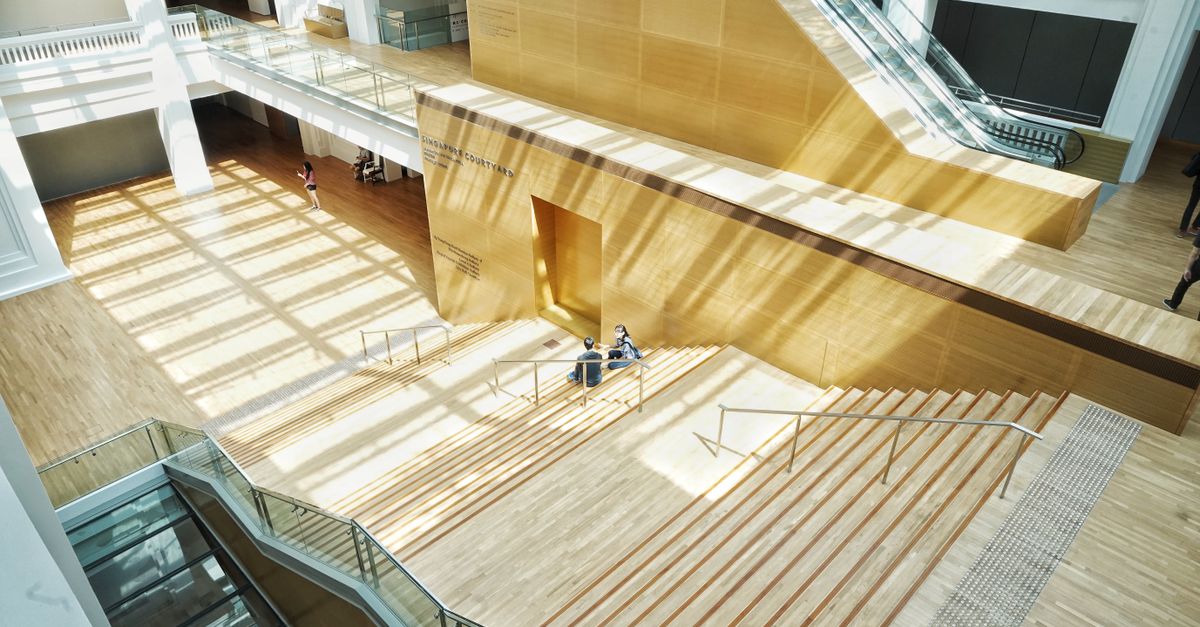
Inside, pay attention to the changes of scale between passageways, circulation areas and galleries. They reveal the meeting of heritage constraints and museum requirements: clear movement, public access and suitable conditions for displaying art.
It would nevertheless be misleading to regard every space as an untouched setting. The conversion combines historic elements with contemporary interventions; the heritage information on site helps distinguish between them.
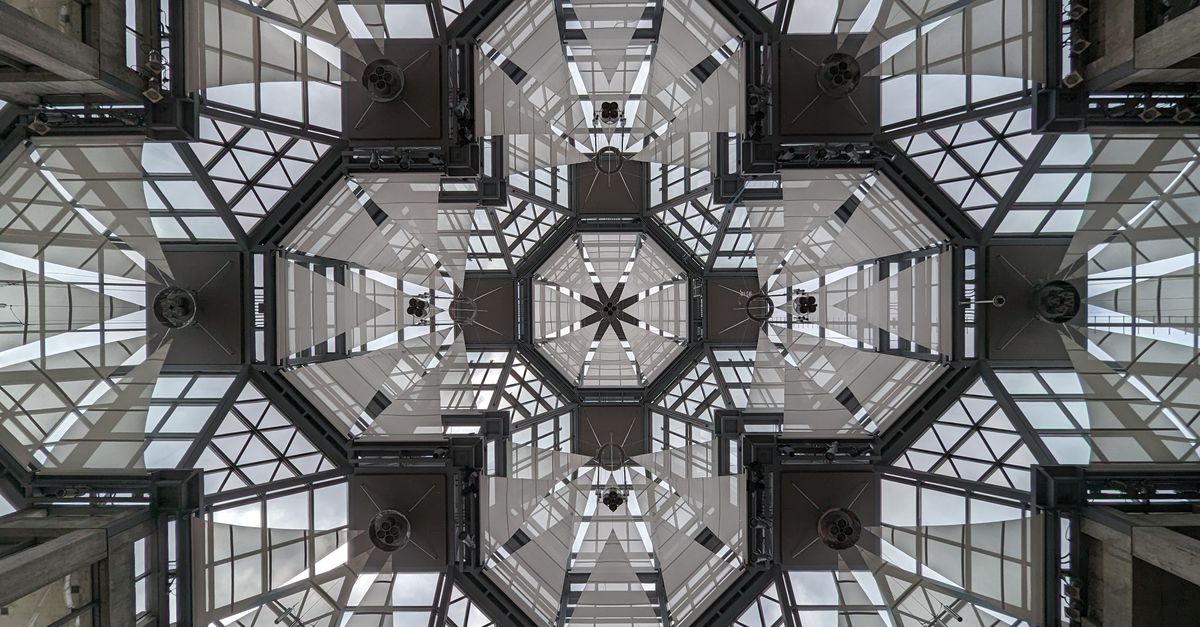
The architectural project was designed by Studio Milou, with French architect Jean-François Milou, in partnership with CPG Consultants. A roof in golden tones and the spaces connecting the buildings bring them together.
This intervention addresses a practical question: how can neighbouring buildings be transformed into a coherent cultural destination without erasing their identity? The connecting spaces play an essential role by organising movement while allowing visitors to perceive the pre-existing structures.
The architectural visit therefore benefits from a simple sequence: look at the façades, observe the junction and then rediscover the old volumes from inside. The building is not merely a container: its transformation is part of the experience.
The permanent collections provide reference points on artists and aesthetic developments, while temporary exhibitions develop a more defined theme. Choose according to your main interest rather than assuming that a ticket covering more spaces is necessarily better.
If you are interested in modern painting, observe how the subject becomes a field for experimentation. Colour relationships, simplified volumes and distorted perspective can matter as much as what is represented.
A thematic route makes this easier. Choosing landscape, the body or the city allows you to compare approaches without having to remember every name; the aim is to understand differences, not accumulate references.
The labels then provide the information needed to refine your first impression. An apparently peaceful image may belong to a period of social change: distinguish what the work shows from what its commentary documents.
Before booking, consult the programme published by the National Gallery Singapore. The subject, presentation dates and access arrangements should be checked directly with the institution, as this information changes.
Do not assume that an exhibition mentioned in a guide is still accessible. Also check whether it requires a specific ticket or separate reservation: the title of a commercial offer does not always make its scope clear.
| Your priority | Route to prioritise | Useful check |
|---|---|---|
| Discover local artists | Presentation devoted to Singapore | Accessible galleries and current display |
| Understand regional exchanges | Southeast Asian presentation | How the route is organised |
| Explore a theme in depth | Relevant temporary exhibition | Dates and admission conditions |
| Explore heritage | Buildings and architectural interpretation | Open spaces and available tours |
The right choice is the one that matches your curiosity and the spaces actually open. This selection also makes ticket planning easier.
For admission tickets, check directly with the National Gallery Singapore for the applicable price, any required documents and the spaces included. Conditions may depend on the visitor’s profile and the programme; do not infer free admission or a discount from old information.
Confirm opening hours, the latest admission time and any closures before travelling. If a particular event interests you, check its conditions separately from those for general admission.
The museum is located in the Civic District. To plan your journey, identify the entrance you want to use, then check the transport operators’ updated information; the Singapore transport guide can help you compare options.
Heat and rain make it useful to plan the final walk. Advice on the Singapore climate can help you adapt your outdoor route rather than fitting it between booked activities.
A guided tour can be particularly useful for connecting the artworks with their regional context. Check with the museum about the language, theme, availability and booking arrangements; a tour devoted to the building will not necessarily cover the same subjects as an art route.
If you have reduced mobility, ask about the adapted entrance, routes and available facilities. With a pushchair or luggage, confirm access and storage arrangements rather than assuming that a service will be available.
Photography rules may also vary between galleries and loans. The signage in each room takes precedence over practices elsewhere in the museum.
Once there, start by checking the map and selecting your priority. This avoids passing through several spaces without really looking at them, especially when the architecture attracts as much attention as the artworks.
In a gallery, first choose a work that catches your eye. Examine its composition, read the label and return to the image: this second look often reveals a detail you initially missed.
Then alternate contemplation, reading and movement. Reading every text systematically can scatter your attention; ignoring the context, on the other hand, can reduce historically important works to their visual effect alone.
With children, start with observable elements: dominant colours, poses or differences between landscapes. A precise question about the image encourages discussion without requiring prior knowledge of art history.
A walk through the Civic District naturally extends your interest in heritage. It places the façades in their urban surroundings rather than treating the gallery as a monument separate from its neighbourhood.
Nevertheless, leave some time between this outing and your next booking. To choose a complementary activity according to your interests, browse things to do in Singapore.
A focused route leaves more room for observation than rushing through a succession of galleries.
The museum presents Singaporean and Southeast Asian art through permanent collections and temporary exhibitions. The historic buildings are also a major part of the visit.
Check the arrangements with the National Gallery Singapore. Depending on the exhibition or activity chosen, a specific reservation may be required; also check which spaces are included in your ticket.
No. The works held in the collections do not all correspond to those currently exhibited. If you are visiting for a particular work, ask the museum whether it is currently on display.
The building lends itself to a heritage-focused visit, combining the former City Hall, former Supreme Court and contemporary connections. Check with the museum about accessible spaces and available architectural tours.
Updated on 30/10/2026
Scroll to see more articles →