Singapore Laws: Chewing Gum, Fines and Banned Items
Discover the main Singapore laws on chewing gum, fines, vaping, drugs, medicines and daily rules to avoid penalties during your stay.
The Merlion stands at Merlion Park, on the edge of Marina Bay, near the mouth of the Singapore River and the Fullerton Hotel. This statue, with a lion’s head and a fish’s body, combines the story behind the name Singapura with the city-state’s maritime past. Its appearance evokes mythology, but its creation served a modern purpose: giving Singapore tourism an instantly recognisable emblem.
To understand this monument, you need to distinguish between the legend, the original design and the sculpture installed on the waterfront. Its location also helps you read the landscape: behind it are the river and the former port district; in front are Marina Bay’s contemporary developments.
In brief
Tradition links Singapore’s name to Prince Sang Nila Utama. According to the story, he saw an animal identified as a lion after arriving on the island, then named the place Singapura, generally translated as “lion city”.
This story belongs to legend, not to an established zoological observation. The identity of the animal described cannot be confirmed. It would therefore be misleading to present this encounter as a proven historical event or to assign it a precise date without evidence.
The hybrid creature visible today does not appear as such in this story. The connection is symbolic: the lion provides a reference to the city’s name, while the aquatic part adds another dimension to its identity.
The scaly body recalls fishing activities and the island’s long relationship with the sea. It also refers to Temasek, an earlier name associated with the site of Singapore, generally linked to the idea of a maritime city rather than translated literally as “fish city”.
This interpretation should not reduce the entire local past to that of a simple fishing village. The island’s geographical position also places it within a history of regional trade and navigation: here, the sea is as much a space for movement as it is a resource.
Why bring these references together in a single silhouette? The combination provides a visual way to tell the territory’s name and its maritime roots. Mythology therefore inspires the emblem, but it is not the story of its creation. This distinction helps explain Singapore’s cultural particularities without confusing founding narratives, history and tourism communication.
Singapore’s National Library Board attributes the design of the symbol to Alec Fraser-Brunner, for the organisation then responsible for tourism promotion, the Singapore Tourist Promotion Board. Originally, it was therefore a graphic identity, not an ancient monument discovered or preserved on site.
The design offered an obvious advantage for tourism: its silhouette could be recognised without a lengthy explanation. The mane, scales and tail combined familiar elements in an unusual form that was easy to reproduce on printed materials and souvenirs.
Calling it a national symbol here describes its place in the collective imagination and in representations of the country. This does not mean that it has the same institutional status as the flag or coat of arms: a tourism emblem and a state symbol serve different purposes.
The National Library Board then distinguishes between the design work of Kwan Sai Kheong and the creation of the statue by local sculptor Lim Nang Seng. This sequence explains why several names appear in its history: creating a design and giving it a monumental form were different interventions.
The water jet reinforces the maritime reading of the whole. It also turns a static silhouette into a moving feature of the landscape, with direction, movement and a recognisable foreground in photographs.
The sculpture thus became a meeting point and a stop on a walk, beyond its original promotional role. Its image appears on tourist goods, but it is its waterfront setting that gives it such presence on site: the surroundings extend the monument’s meaning.
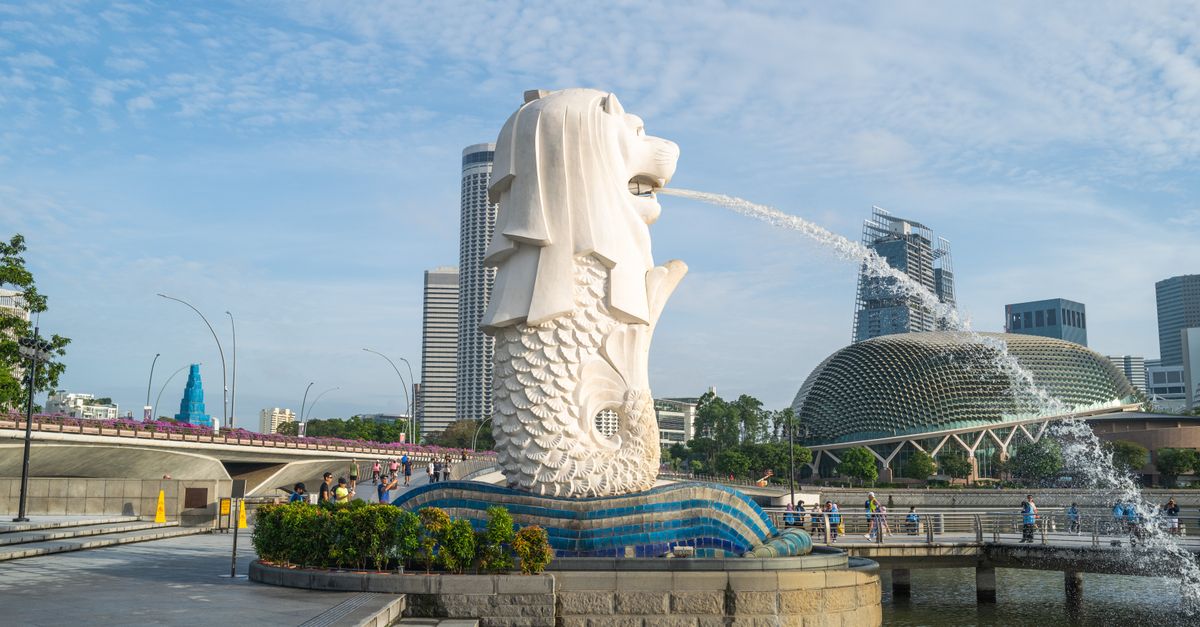
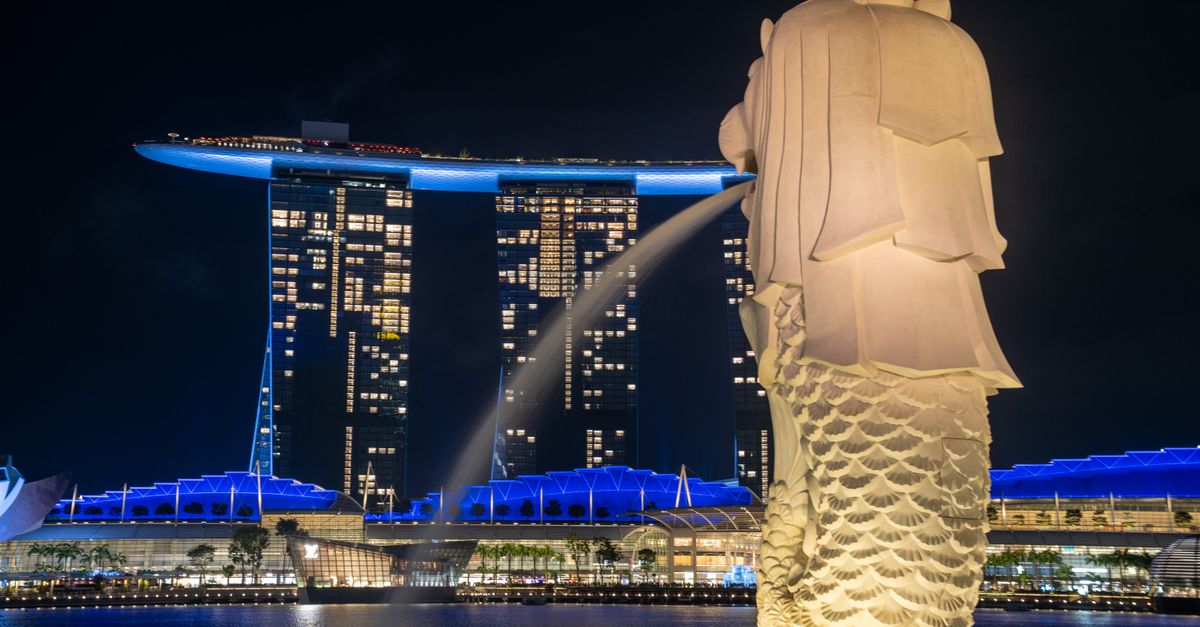
The iconic statue stands at Merlion Park, on the Marina Bay waterfront. The Fullerton Hotel is a nearby landmark, while Marina Bay Sands is on the other side of the bay. The Esplanade can also help you find your bearings in this part of the city centre.
This is not a landscaped park isolated from the urban fabric. It functions mainly as a tourist esplanade connected to the waterfront promenades, where visitors come to see the sculpture, photograph the bay and continue their sightseeing on foot.
From around Raffles Place, you can head towards the Fullerton area and then the waterfront. The exact route depends on which exit you use and on any temporary changes; check the Land Transport Authority and the relevant operator for up-to-date transport conditions.
| Landmark | How it helps your visit |
|---|---|
| Merlion Park | The destination to search for when heading to the famous statue by the bay. |
| Fullerton Hotel | A nearby architectural landmark, on the river side. |
| Raffles Place | An MRT station offering a walking approach through the business district. |
| Esplanade | A cultural landmark from which to continue your walk along the waterfront. |
| Marina Bay Sands | A complex on the opposite shore of the bay, visible from around the monument. |
The sculpture has not always occupied its current position. It was moved after developments in the area, particularly the Esplanade Bridge, changed its visibility from the bay.
A chronological shortcut should be avoided: the contemporary panorama is not exactly the same as the one that existed when it was installed. Marina Bay Sands belongs to a later stage in the area’s transformation; it was therefore not part of the original setting when the statue was moved.
To plan your route, our guide to getting around Singapore complements these landmarks. Searching for Merlion Park, rather than only the creature’s name, helps avoid confusion with its other representations.
As the site is outdoors, comfort depends largely on the weather. Arriving early in the day may make the walk more pleasant, but neither cool conditions nor an absence of visitors is guaranteed; the area remains a very popular tourist stop.
At the end of the day, the light gradually changes across the bay. This period suits visitors who want to watch the transition from the daytime landscape to illuminated façades, without organising their entire visit around one specific photograph.
Weather remains the priority, particularly in the event of a storm. Check the forecasts and alerts from the Meteorological Service Singapore before setting off. Our guide to the climate and seasons in Singapore can help you anticipate tropical conditions.
To show the head and body clearly, a slightly side-on composition is often easier to read than a view taken directly beneath the jet. A wider shot places the figure in its surroundings and makes its relationship with the bay clear.
The perspective that makes it look as though you are drinking the projected water is common. However, it requires you to stand at a distance: make sure your composition does not block the route or require you to cross a barrier.
Wind can blow spray towards visitors. Protect devices that are sensitive to water and watch out for wet surfaces, especially when looking at your phone screen rather than the ground.
Access to the surrounding area and the fountain’s operation may be affected by construction or maintenance work. The presence of the sculpture does not guarantee that the water jet will be working when you visit.
Check updated notices with the Singapore Tourism Board before making a journey specifically for the monument. During events around the bay, also consult the organisers’ official information about routes and restrictions; the Singapore events calendar helps place these periods within your stay.
Walking upstream from the monument changes your view of the city centre. Your attention shifts from Marina Bay’s broad panorama to the quays, bridges and buildings connected with the area’s commercial history.
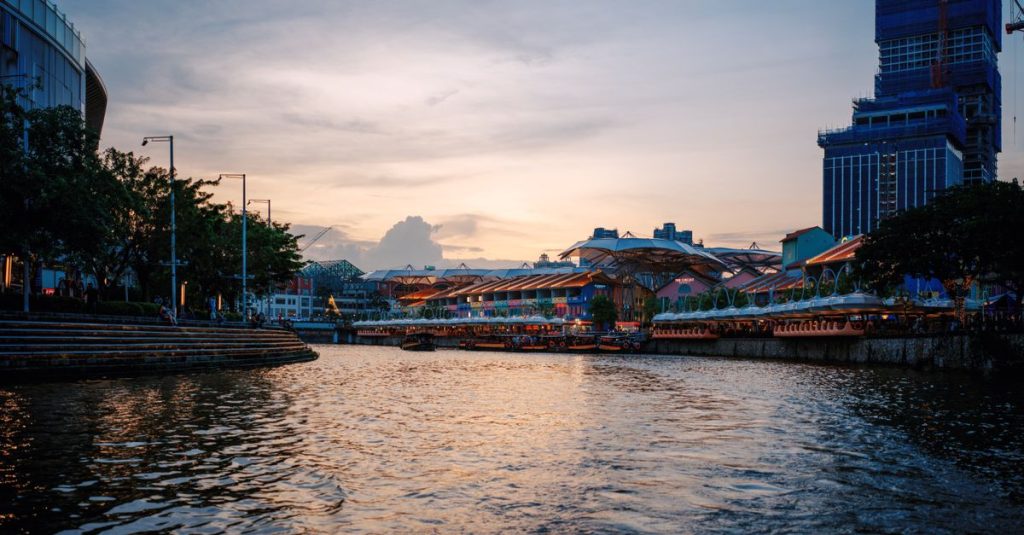
Boat Quay is a possible continuation for discovering the relationship between the older waterfront and the business district. The interest is not only architectural: the walk shows how riverside spaces now accommodate restaurants, pedestrian traffic and tourism activities.
Heading towards the Esplanade instead opens the visit onto cultural facilities and views across the bay. These routes suit different interests; it is better to choose one coherent direction than to make repeated journeys in the heat.
To extend this discovery, explore other walks and attractions in Singapore, including Gardens by the Bay. The connecting theme remains water: it links the creature’s meaning, the former port landscape and today’s developments.
Several representations of this emblem have existed in the city-state. A smaller sculpture also stands in the Merlion Park area, but it should not be confused with the large fountain facing the bay.
The large Merlion on Sentosa no longer exists. Descriptions that still present it as an attraction to visit are therefore out of date. Its former presence on the island nevertheless explains why it appears in older photographs and travel accounts.
This distinction matters when planning an itinerary: Sentosa and the Marina Bay waterfront are different destinations. To see the monument associated with the best-known city-centre panorama, Merlion Park is the place to remember. See our Sentosa guide for the island’s current attractions.
Comparing older images with the present-day landscape mainly reveals how the waterfront has changed. The symbol remains recognisable, while the city around it continues to evolve.
It stands at Merlion Park, on the edge of Marina Bay, near the mouth of the Singapore River and the Fullerton Hotel. Raffles Place is a possible MRT access point, followed by a walk.
The head refers to Singapura, generally translated as lion city, and to Sang Nila Utama’s legendary story. The fish’s body evokes the island’s maritime origins and fishing activities.
The hybrid figure is a modern creation intended for tourism promotion. It combines references to the maritime past and the lion legend, but that legend does not describe an encounter with a half-lion, half-fish being.
No, this former attraction was demolished. To see the famous fountain statue on the waterfront, go to Merlion Park and check for any maintenance notices with the Singapore Tourism Board.
Updated on 14/10/2026
Scroll to see more articles →