Singapore Laws: Chewing Gum, Fines and Banned Items
Discover the main Singapore laws on chewing gum, fines, vaping, drugs, medicines and daily rules to avoid penalties during your stay.
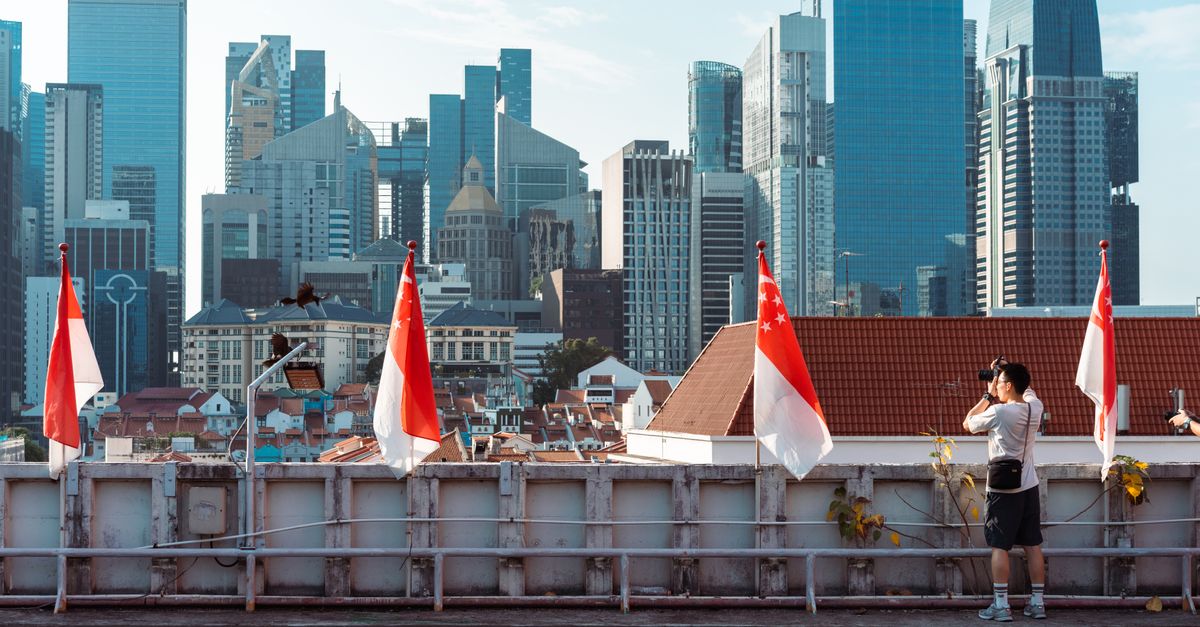
The Singapore flag combines red, symbolising fraternity and equality, with white, representing purity and virtue. Its crescent moon evokes a young nation on the rise, while its stars express the ideals of democracy, peace, progress, justice and equality. This civic meaning, presented by the National Heritage Board, helps explain the emblem without reducing it to a religious or community affiliation.
Its history began before independence: it first accompanied the territory’s internal self-government, then became the flag of a sovereign state. To recognise it, understand its colours or display it correctly, you need to distinguish between its design, its official symbolism and the rules governing its use.
In brief
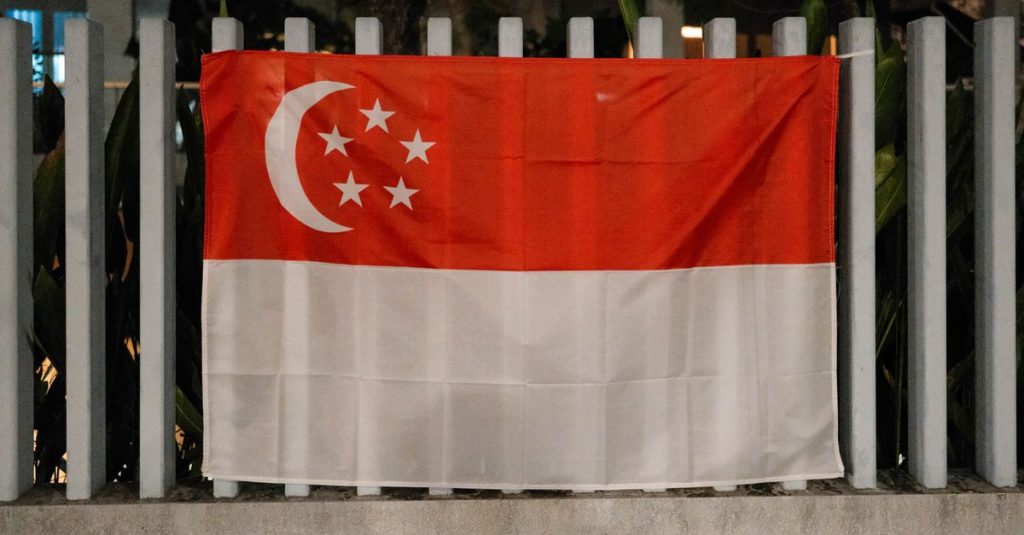
The design is based on horizontal bands of equal height: red on top, white below. The white motifs are grouped in the upper section, on the side where the fabric is attached to the pole, an area known as the canton in heraldic terminology.
This arrangement is a more reliable reference than a shade observed in a photograph. Lighting, folds in the fabric and screen settings can alter how the colour is perceived, but not the overall organisation of the design.
The National Heritage Board associates red with universal brotherhood and equality among human beings. It gives white the meaning of purity and virtue, qualities intended to be lasting and universal.
Red also has a strong presence in Chinese culture, particularly during celebrations. This cultural association does not, however, replace the national definition: on this emblem, the colour does not represent a particular community.
| Element | Appearance | Official meaning |
|---|---|---|
| Upper section | Red | Universal brotherhood and equality |
| Lower section | White | Purity and virtue |
| Crescent | White, near the hoist | Young nation on the rise |
| Stars | White, arranged in a circle | Democracy, peace, progress, justice and equality |
For a poster, textile print or educational document, it is better to use an official file than to redraw the motif from a photograph. A colour code sampled from an arbitrary image does not guarantee an accurate reproduction.
You should also avoid stretching the image to fill a space: this distorts the stars and changes the balance of the canton. Accuracy concerns the arrangement of the elements as much as their colour.
The crescent moon represents a young nation on the rise. This interpretation, given by the National Heritage Board, places the motif within a movement: that of a country building its future, rather than treating it as an exclusively religious reference.
The same organisation attributes the ideals of democracy, peace, progress, justice and equality to the five stars. Their circular arrangement brings these principles together in a single visual composition, without assigning each star to a population or territory.
The presence of this motif may evoke Islam, particularly when compared with other national emblems. However, a similar design does not necessarily have the same meaning from one country to another.
In Singapore, the official explanation concerns the nation’s rise. Presenting the crescent as proof of an exclusively Muslim national identity would therefore be misleading and would fail to reflect the country’s religious diversity.
Another misconception is to look for an ethnic or religious group behind each star. The official symbolism does not work this way: it sets out principles intended for all citizens.
The visual resemblance to the Chinese flag is not enough to establish a political equivalence either. The colour of the motifs, their arrangement and, above all, their national definition are different.
Why does this distinction matter? Because it separates possible visual influences from the meaning adopted by the state. To understand the collective customs surrounding these signs, our page on festivals and celebrations in Singapore provides additional context.
The emblem brings people together around shared ideals; it is not a map of community affiliations.
The National Heritage Board dates the appearance of the current flag to 1959, when Singapore gained internal self-government. The territory had a government responsible for its domestic affairs, but was not yet a fully independent state. For more context, see our guide to Singapore’s political status.
It needed symbols capable of embodying this new political situation. Choosing its own flag was therefore part of the construction of a public identity, alongside the coat of arms and national anthem.
The National Heritage Board recalls the official presentation of the new national symbols on 3 December 1959. This moment marked their entry into public life and should not be confused with the later achievement of sovereignty.
This distinction explains why the date of adoption and the date of independence are different. A community can adopt a political emblem before it controls the full range of powers of a sovereign state.
According to the National Heritage Board’s historical timeline, Singapore joined Malaysia on 16 September 1963, then became independent on 9 August 1965. The Singaporean design passed through these changes without being replaced.
This continuity is essential: political separation did not lead to the creation of a new composition. The already familiar flag became that of a sovereign republic, strengthening its role as a link between self-government and independence.
Accounts that attribute every detail to a single ethnic or ideological claim oversimplify this history. In particular, you need to distinguish the political context of the design from the civic meaning officially attached to the result.
During a visit, historical presentations by heritage institutions can place these stages within their colonial and regional context. Our ideas for cultural visits in Singapore can complement this discovery.
The design remains stable while the territory’s political status changes.
The most immediate resemblance is to Indonesia: its flag also has red above white. To identify Singapore, you should therefore look first at the canton, where the crescent and stars appear. Our guide to Singapore’s geography and neighbouring countries provides further context.
This method remains useful when the fabric is partly folded. A photograph showing only the coloured bands will not always provide a definite answer; you need to look for the motifs or examine a more complete view.
The Indonesian flag does not have the white stars and crescent found on Singapore’s flag. Monaco’s flag also uses red followed by white, without these motifs: colour alone is therefore not enough to identify the country.
Poland presents another visual trap, but the order is reversed: white is above red. Before interpreting a photograph, you should nevertheless check that it shows the flag in its normal orientation.
Malaysia is a different case. Its emblem also includes a crescent and a star, but combines a blue canton with red and white stripes; its composition is clearly different from Singapore’s.
A building, sign or caption may help, but these clues remain secondary. A Singaporean representation may appear abroad, at a sporting event or on a diplomatic building.
Conversely, a scene photographed in the city-state may show foreign flags. The location therefore does not replace observing the design.
For educational material or a publication, compare a complete representation rather than cropped images. Check the colour order, the presence of the motifs and their position near the hoist in turn: this approach avoids relying on an approximate shade.
The most useful distinguishing feature remains the combination of the crescent and stars in the upper band.
The flag has an important place in public ceremonies and events linked to National Day. On façades, in communal spaces or during a parade, it expresses a shared belonging rather than being merely decorative.
For anyone moving to Singapore, understanding this role helps you interpret the everyday environment. Patriotic decorations should not be confused with those used for religious festivals or commercial celebrations.
The conditions for displaying and reproducing the flag should be checked with the relevant authorities. Consult the up-to-date guidance from the Ministry of Culture, Community and Youth and the National Heritage Board before a public installation, campaign or commercial use.
You need to distinguish between a suspended flag, a documentary photograph and a motif incorporated into a product. These uses are not necessarily governed in the same way; permission applicable to one situation should not be assumed to apply to all others.
For a façade or balcony, the building manager’s instructions may also apply. These concern the physical installation and safety, independently of the object’s symbolic significance.
On a brochure, cropping can remove part of the motifs; on a textile, a seam can alter their arrangement. Using a reference file and checking the final result reduces these errors, but does not remove the need to verify the conditions of use.
The same care applies to events: you should not assume that an element seen during a parade can be freely reused in an advertisement. A ceremonial context and commercial exploitation follow different principles.
Finally, the coat of arms, anthem and national flower each have their own function. They belong to the same family of national symbols, but are not interchangeable with the flag.
Respectful use begins with an accurate design and checks suited to the context.
The National Heritage Board associates red with universal brotherhood and equality among human beings. White represents purity and virtue.
Its official meaning on this emblem is that of a young nation on the rise. Reducing it to a religious reference does not correspond to this national definition.
No. They express the ideals of democracy, peace, progress, justice and equality, rather than ethnic or religious groups.
The colours are arranged in the same order, but the Singaporean flag has a white crescent and stars in its upper corner, near the hoist. These motifs are absent from the Indonesian flag.
Do not assume that this use is unrestricted. Check the current conditions with the Ministry of Culture, Community and Youth and the National Heritage Board, specifying the intended medium and use.
Updated on 09/10/2026
Scroll to see more articles →