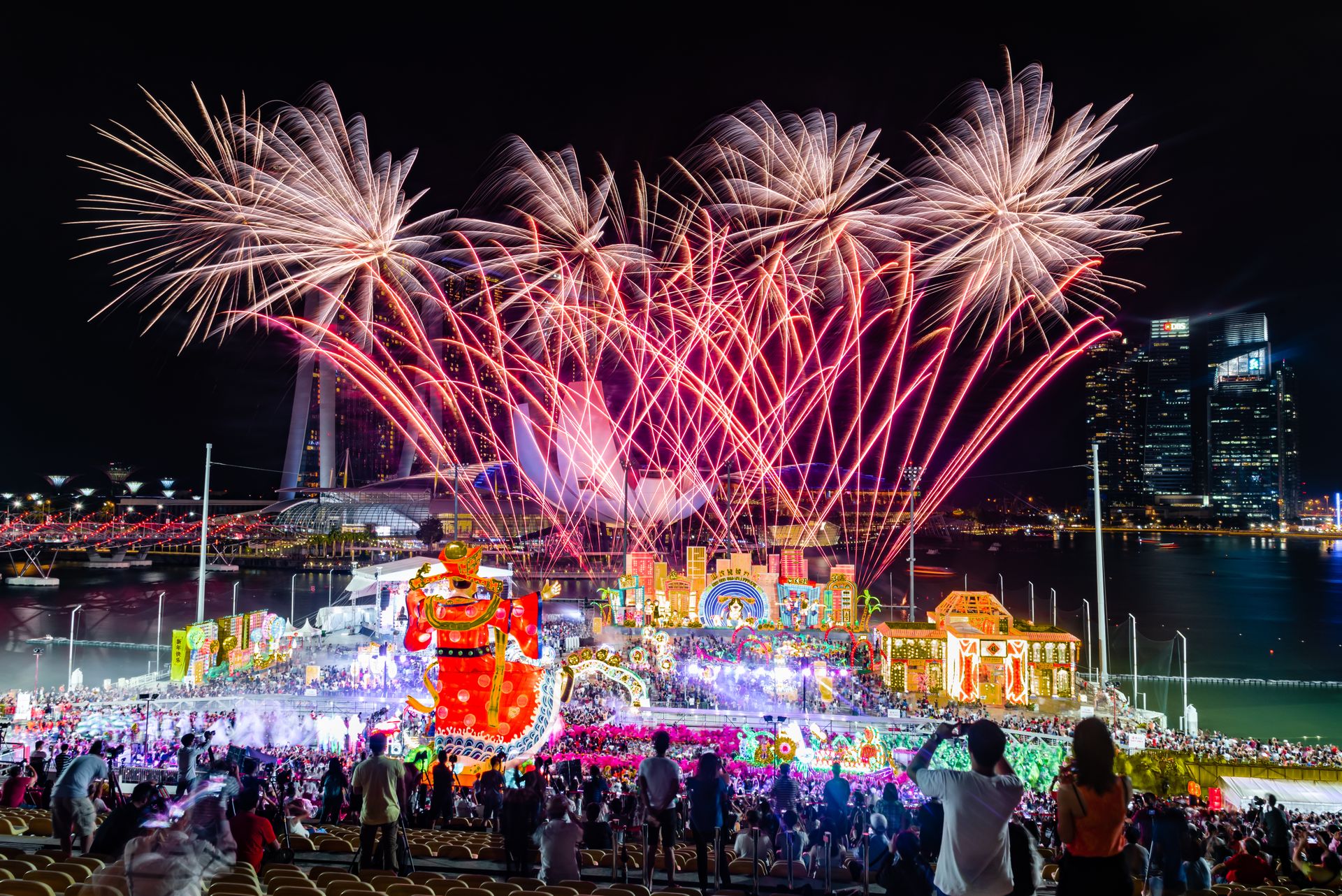
Weddings & Festivals in Singapore
Chinese, Malay and Tamil traditions — rituals, the 2026 calendar and the etiquette for taking part.
Singapore celebrates 11 official public holidays reflecting its four main communities: Chinese, Malay, Indian and Eurasian. These dates are joined by hundreds of private wedding ceremonies, showcasing living traditions. Understanding these rituals allows you to experience the city-state fully rather than observing it from the outside.
Key points
- ✔3 traditions coexist: Chinese wedding (tea ceremony), Malay wedding (bersanding) and Tamil Indian wedding (muhurtam)
- ✔11 public holidays, including Hari Raya Puasa, Deepavali, Thaipusam and Chinese New Year — MOM dates for 2026
- ✔Chinatown, Little India and Geylang Serai: three neighbourhoods transformed into festive settings accessible to everyone
- ✔Strict dress code: shoulders and knees covered in temples, mosques and at private ceremonies
- ✔Flights Paris → Singapore from €539 return in July 2026 (Travelpayouts, 30/06/2026)
Sources: MOM (mom.gov.sg) · Roots.gov.sg · STB (visitsingapore.com) · Travelpayouts, 30/06/2026.
The 3 main wedding traditions
Rituals, symbolism and dress code for guests
Chinese wedding: the tea ceremony
The bai cha (拜茶, tea service) is at the heart of a traditional Chinese wedding. The newlyweds serve tea to parents and elders in a specific order, and in return receive red envelopes (ang bao) and gold jewellery.
- →Dominant colours: red and gold, with the double-happiness symbol (囍) everywhere
- →Banquet with 10 to 20 tables at a Cantonese restaurant or grand hotel
- →Usual gift: red envelope of 100–300 SGD per couple
- →Dress code: formal attire, avoid white and black (mourning colours)
Double-happiness (shuāngxǐ)
symbol of a happy union
The 3 key moments
- Bridal procession (morning)
- Tea ceremony (midday)
- Wedding banquet (evening)
The bersanding:
the newlyweds sit side by side on a throne
Malay wedding sequence
- Akad nikah (religious contract)
- Berinai (henna, the day before)
- Bersanding (marital throne)
- Salam (guests’ blessings)
Malay wedding: the akad nikah and bersanding
Malay weddings are governed by Islamic law (solemnised by the Kadi). The akad nikah is the religious contract recited by the bride’s father. The following day or later the same evening, the bersanding seats the newlyweds on a flower-covered throne to the rhythm of the kompang (drums).
- →Guest attire: baju kurung or understated formalwear, with shoulders covered
- →Women wear a headscarf in religious spaces
- →Gift: envelope or household item (no alcohol)
- →Food: nasi minyak, rendang, sweet kuih — open buffet
Tamil wedding: the muhurtam and mehndi
A Tamil Hindu wedding follows a precise astrological calendar: the muhurtam is the auspicious time determined by a Brahmin priest. The day before, the mehndi ceremony decorates the bride’s hands and feet with henna.
- →Venue: Hindu temple (Sri Mariamman, Sri Veeramakaliamman…) or multi-purpose hall
- →Bridal colours: red and gold, sari, traditional gold jewellery
- →Dress code: remove your shoes, cover your shoulders, no leather in the temple
- →Gift: envelope, tableware or wedding-list item — gold is appreciated
Sacred oil lamp
lit during the ceremony
Typical programme
- Mehndi (henna, the day before)
- Muhurtam at sunrise
- Garland exchange (maalai)
- Vegetarian meal served on a banana leaf
Official festival calendar 2026
11 statutory public holidays (source: MOM Singapore, mom.gov.sg)
| Festival | Date 2026 | Community | Neighbourhood to visit |
|---|---|---|---|
| New Year’s Day | 1 Jan | All | Marina Bay (fireworks) |
| Thaipusam | 25 Jan | Tamil Hindu | Little India → Sri Thendayuthapani |
| Chinese New Year ×2 | 17–18 Feb | Chinese | Chinatown (River Hongbao) |
| Labour Day | 1 May | All | — |
| Vesak Day | 5 May | Buddhist | Kong Meng San Temple |
| Hari Raya Puasa | 20 March (est.) | Muslim | Geylang Serai (bazaars) |
| National Day | 9 August | All | Padang / Marina Bay |
| Hari Raya Haji | 27 May (est.) | Muslim | Sultan Mosque |
| Deepavali | Late Oct./Nov. | Hindu | Little India (illuminations) |
| Christmas | 25 Dec. | Christian / All | Orchard Road |
Official dates published on mom.gov.sg. Some Islamic celebrations (Hari Raya) follow the lunar calendar — final dates are announced a few days beforehand.
How to take part as an expat
Singapore is one of the few cities in the world where a foreigner can attend a Hindu ceremony in the morning, have a Chinese New Year lunch in the afternoon and visit a Hari Raya bazaar in the evening.
Chinatown comes alive
During Chinese New Year (Feb.), the streets of Chinatown are closed to traffic. Street food stalls, lion dance performances, parades — free entry, open to everyone.
Geylang Serai
The month of Ramadan transforms Geylang Serai into a huge night market. Hundreds of stalls selling kuih, satay and bandung — Singapore's most vibrant atmosphere.
Little India lit up
Deepavali (Oct./Nov.) and Thaipusam (Jan./Feb.): Little India is transformed. The Thaipusam procession, with kavadi carried as offerings, is a one-of-a-kind experience.
See also: Singapore's cultural specifics and festival guide
Flights from Paris → Singapore: prices in 2026
Travelpayouts/Aviasales data recorded on 30/06/2026
Return prices (€) by departure month
* Actual data: July (€539, 2 stops) and August (€618, EY). Off-season: average estimate.
July 2026 is the cheapest month found at €539 return (2 stops, departing 27/07 — Travelpayouts, 30/06/2026). Ideal for arriving before National Day on 9 August, one of Singapore's most spectacular events.
✈ Compare flights from Paris → SingaporeIndicative prices. Sources: Travelpayouts/Aviasales Data API, recorded on 30/06/2026. Fares vary according to availability and booking date.
Codes and etiquette: what you need to know
👗 Dress code
- ✔Chinese wedding: formal dress or suit. Avoid white (mourning) and all-black outfits. Red is welcome.
- ✔Malay wedding: baju kurung or modest clothing. Shoulders and knees covered. Women: headscarf recommended.
- ✔Hindu temple: shoes removed at the entrance. Shoulders covered, no leather. Bare feet in the shrine.
- ✔Mosque: women must cover their heads (headscarves provided at the entrance), men must not wear shorts. Entry is possible outside prayer times.
🎁 Gifts and customs
- ✔Red envelope (ang bao): customary for a Chinese wedding. Amount: SGD 100–300 per couple, depending on your relationship with the newlyweds.
- ✔Malay wedding: white envelope or household gift. Alcohol is excluded. Arrive on time — meals are served in waves.
- ✔Hari Raya Puasa: bring cakes (kuih) if you are invited to someone's home. Duit raya (green envelope) is for children.
- ✔Deepavali: a box of Indian sweets (mithai) is much appreciated when visiting people's homes.
Getting married in Singapore as an expat: ROM or ROMM
Civil marriage, Muslim marriage: the administrative process to know before booking anything
ROM — Registry of Marriages
The ROM handles the legal registration of civil marriages, regardless of the spouses' nationality. It is the most straightforward option for most expat couples seeking clear legal recognition in Singapore.
- →21-day notice period mandatory before registration — factor this into your schedule before booking a venue
- →Documents to be confirmed on a case-by-case basis depending on nationality and previous marital status (valid passport, civil-status documents, translations if needed)
ROMM — Registry of Muslim Marriages
For a Muslim marriage, registration is handled by the ROMM, not the ROM. The legal and religious framework is specific: the documents required and the steps involved differ from the standard civil procedure.
- →The religious marriage (bersanding, akad nikah — see the Malay tradition above) has legal validity only if it is properly registered through the ROMM
- →Timeframes depend on the completeness of the application and the Kadi's availability — check early
Checklist before booking a venue
- ✔Check the type of marriage: civil through the ROM or Muslim through the ROMM
- ✔Check passport validity and the spelling of names
- ✔Confirm the 21-day notice period for a civil marriage
- ✔Only book the venue once you have a clear understanding of the administrative timeline
Must be checked before taking any action: rom.gov.sg — document requirements vary depending on nationality and personal circumstances.
The impact of major festivals on expat life
Chinese New Year, Hari Raya, Deepavali, National Day: what practically changes at work, on public transport and for your bookings
The impact of major festivals on expat life
Quickly compare the practical impact of major festivals on shops, transport, the atmosphere at work and useful everyday tips.
Quick summary
All festivalsTip: click on a festival to see its practical impact on everyday life in Singapore.
Quick guide
Expat tip
Book early, check reduced shop opening hours and plan your journeys ahead of public holidays.
Organising your own wedding in Singapore: venues and budget
Indicative ranges — adjust according to level, season and number of guests
| Type of reception | Indicative budget range | Lead time to allow for |
|---|---|---|
| Private restaurant | From several thousand SGD, depending on the menu and number of guests | Several months in advance |
| Hotel / banquet hall | Mid- to high-range, with services often included | Long lead time, especially for sought-after dates |
| Rooftop / signature venue | High budget, with an additional cost for prestige and the view | Very high demand, secure it early |
| Garden / hybrid space | Varies according to the services and wet-weather solution | Depends on the season and weather logistics |
The biggest costs in a Singapore wedding budget remain the venue, catering, decoration and photography. A small reception can start with a budget of several thousand SGD; a hotel or rooftop wedding with full services can quickly rise far beyond that. It is better to work with broad ranges and keep a margin for rain, extras and last-minute guests rather than aim for an overly precise figure.
Good to know
The neighbourhood matters just as much as the venue: Orchard/Tanglin for a central, accessible setting, East Coast/Katong for a residential seaside atmosphere, Holland Village/Bukit Timah for a leafy setting, and Marina Bay/Clarke Quay for skyline views. The best choice is ultimately the one that fits the couple's lifestyle, rather than one based solely on prestige.
Frequently asked questions
What are the main official festivals in Singapore?
What is a Chinese wedding in Singapore like?
How can tourists or expats take part in local festivals?
What dress code should be followed at a ceremony in Singapore?
What is the difference between the ROM and ROMM in Singapore?
How much time should be allowed for a civil marriage in Singapore?
Do major festivals really change expats' daily lives?
What budget should be allowed for organising a wedding in Singapore?
Do the arrangements need to be confirmed with an official source?
Sources
- • MOM Singapore — Public Holidays 2026 (mom.gov.sg)
- • Roots.gov.sg — Chinese Wedding Customs in Singapore
- • Singapore Tourism Board — Festivals & Events (visitsingapore.com)
- • Travelpayouts/Aviasales Data API — PAR→SIN flight prices recorded on 30/06/2026
- • Pexels — hero photo (ID 5651081)
This article is for information purposes only. Religious rituals vary according to families and generations. Check the dates of Islamic festivals each year on mom.gov.sg.