
Master English in the Heart of Asia
In 2026, Singapore is more than ever establishing itself as the ultimate destination for total language immersion. Combine prestigious education with tropical dynamism.
Why choose Singapore to learn English?
Singapore is not just a global financial centre; it is a unique linguistic laboratory. Although Mandarin, Malay and Tamil are official languages, English is the language of administration, business and education. For a French-speaking expat, settling here is an opportunity to experience 24/7 immersion.
Contrary to popular belief, the English spoken in Singapore follows British standards in academic and professional settings. You will learn “global” English, essential for your international career, while discovering the subtleties of Singlish, the colourful local creole that shapes the identity of the city-state.
A structured and flexible range of courses
Courses for Adults & Professionals
Intensive programmes of 20 to 35 lessons per week, designed for rapid progress. Ideal for those wishing to boost their employability or prepare for a long-term move abroad.
- ✓ Beginner to Advanced levels
- ✓ Exam preparation (IELTS, TOEFL)
- ✓ Focus on speaking skills

Private Lessons
Tailored support to address specific gaps or prepare for an important professional presentation.
Find a tutor →Total Immersion
Stay with a local family to practise English after lessons and discover Singaporean culture.
View EF options →The Teaching Approach
Teaching in Singapore is based on a careful balance between listening comprehension, written expression and, above all, active conversation. Classes are deliberately kept small (10–12 students) to ensure everyone has plenty of speaking time.
Strategic Location
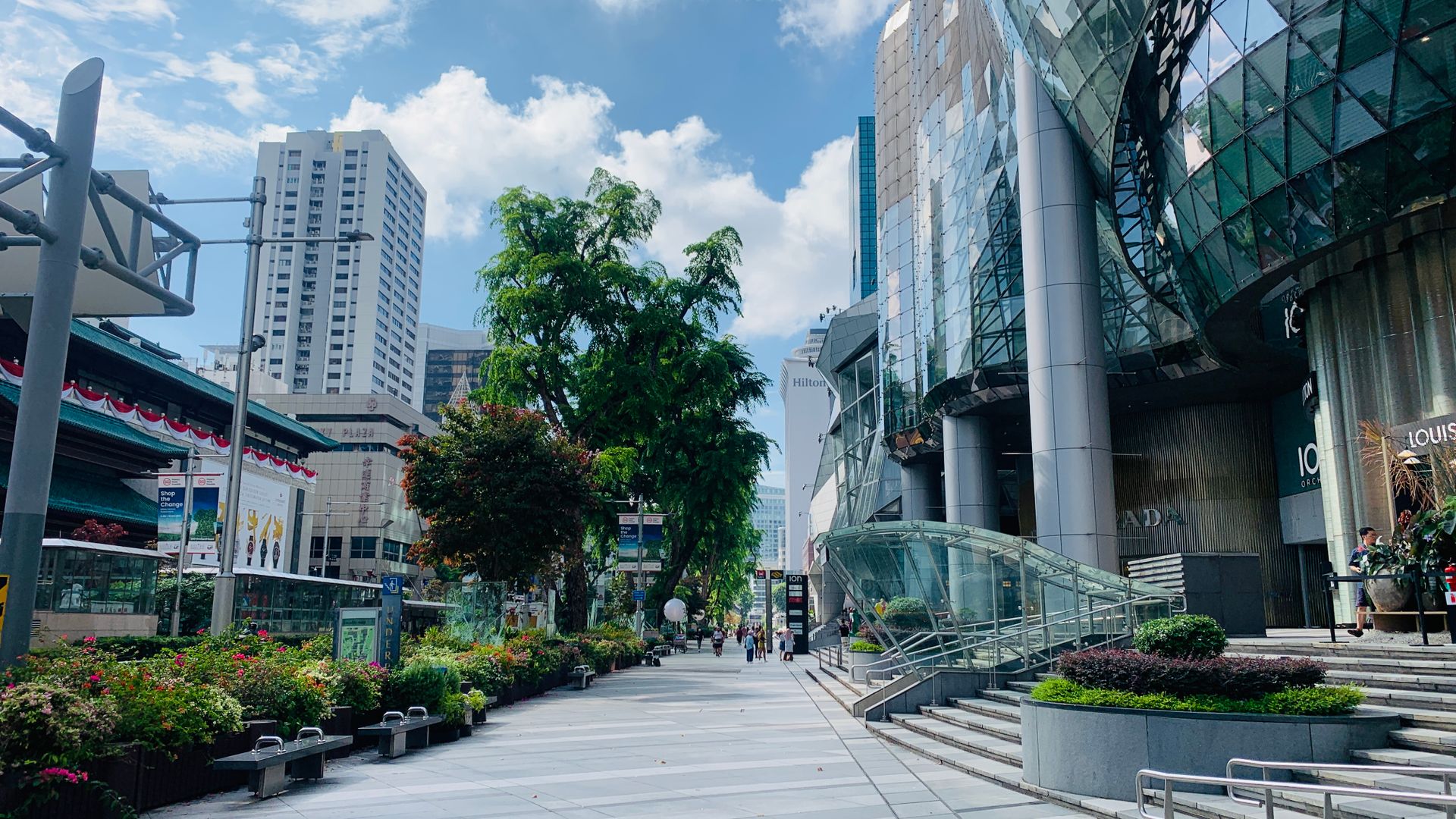
Most language centres are located in the Central Business District (CBD) or near Orchard Road. Accessible via an exceptional transport and mobility network, these schools offer modern facilities: multimedia rooms, relaxation areas and high-speed Wi-Fi.
Invest in your future: Costs to expect
The cost of a language stay in Singapore varies depending on the intensity of the lessons and the time of year. On average, expect to pay between 400 and 800 SGD per week in tuition fees.
Important Note on Visas
Warning: a Student’s Pass in Singapore does not allow you to work, except under very specific conditions for certain prior work permits. Make sure you have a sufficient budget before your arrival.
Progress & Budget Calculator
2026 Estimate
5 Strategies for Lasting Fluency
SMART Goals
Don’t say “I want to speak English.” Say “I want to be able to lead a 30-minute meeting in English within 3 months.” Precision is the key to success.
Turning Mistakes into Progress
In Singapore, no one will judge you on your accent. Singaporeans appreciate the effort to communicate. The more mistakes you make, the faster you learn.
Digital Immersion
Set your phone to English, listen to local podcasts (such as “The Straits Times”) and use translation tools for unfamiliar words you encounter each day.
Language Tandems
Swap your French for English! Many locals want to learn the language of Molière. Visit our community forum to find a partner.
Go Off the Beaten Track
Go to a Hawker Centre and order in English. Chat to taxi drivers. Real language is spoken in the street, not just in books.
Need help?
Our experts will help you free of charge to find the best school for your profile.
Contact an adviserA Short Language Survival Guide
| French | English (Standard) | Singlish / Mandarin (Useful) |
|---|---|---|
| How much does it cost? | How much is this? | How much ah? / Duo shao qian? |
| It’s too expensive! | It's a bit expensive. | So expensive one! / Tai gui le! |
| I would like this. | I would like this one. | This one, lah! |
| Thank you very much. | Thank you very much. | Thanks ah! / Xie xie! |
| Can you help me? | Can you help me? | Can help? / Bang mang? |
Note: To explore Mandarin further, see our Guide to Learning Mandarin.
Yes, you can take a language course in Singapore and learn English there, provided you choose a course suited to your objective and check the formalities applicable to your nationality. English is a working, teaching and communication language between the country’s different communities. This central role allows you to continue practising it in shops, on public transport, during cultural activities and in professional life.
The choice is not limited to intensive programmes: private schools, the British Council, evening classes, individual support and certain community centre activities meet different needs. To organise your departure, you need to consider the course content, your right to attend the course, accommodation and the cost of living together. A tourist stay and admission to a school do not automatically grant the same rights: this distinction is particularly important for longer courses.
Language course in Singapore: what kind of English do you learn there?
Singapore offers a favourable environment for learning English, but immersion is neither exclusively English-speaking nor automatic. The city-state is multilingual: English coexists notably with Mandarin, Malay and Tamil, as well as with other languages used in families and everyday interactions.
English in Singapore: the language of work and communication
English plays a central role in businesses, educational establishments and public services. For a learner, this means being able to read practical information, ask a shopkeeper a question or take part in an activity without having to master another local language.
This presence offers a practical advantage when developing several skills at once. Announcements and conversations improve listening comprehension, while forms, signs and the local press introduce learners to a variety of written usage.
The international setting also exposes learners to different accents. This is particularly useful when preparing for a career in a multicultural environment: understanding only your teacher’s voice is not always enough to follow a meeting involving people from several countries.
It is nevertheless important to distinguish accessibility from progress. Ordering a meal with a few words you already know reinforces an automatic response, but a sustained conversation, a presentation or an accompanied reading exercise requires a broader vocabulary and more developed sentence construction.
Standard English and Singlish: understanding the differences
Singlish is a familiar variety of English specific to the Singaporean context, shaped by contact between local languages. You may hear distinctive turns of phrase, highly condensed sentences and particles such as « lah », whose role depends on the context and intonation.
It should not be presented as simply incorrect English. It has a social and cultural function, but its usage does not always match the expectations of an international examination, academic writing or formal professional communication.
A course for international learners should therefore teach standard English while also providing guidance to help them understand local conversations. The aim is not to erase Singaporean characteristics, but to recognise the appropriate register and adapt your own expression.
When faced with an unfamiliar formulation, asking someone to rephrase it is more useful than repeating an expression without understanding its meaning. This approach also develops an essential skill: keeping the conversation going despite a comprehension difficulty.
Building genuine language immersion
Singapore’s cultural diversity provides many authentic learning resources. Museum collections, library programmes and guided tours in English offer exposure to vocabulary different from that found in textbooks, relating to history, the arts and the environment.
These activities become educational when they are prepared for and followed up afterwards. Reading an introduction before a visit, noting down a few expressions during the activity and then describing what you understood turns an outing into a complete exercise, without reducing your stay to a succession of attractions.
Your social circle also plays a decisive role. An international residence or a group activity can encourage interaction, but there is no guarantee that participants will spontaneously speak English with one another: you need to choose situations in which English genuinely serves as a shared means of communication.
To explore this approach further, the advice on learning English in Singapore can complement your preparations. The quality of immersion depends above all on the regularity of interactions and the feedback you receive on your difficulties.
English courses in Singapore: comparing schools and programmes
The right institution is the one whose programme, timetable and admission requirements match your plans. A well-known provider or a promise of an innovative method does not replace examining the course content, the support provided and the contract.
Private schools and the British Council: what criteria should you consider?
Depending on the institution, private language schools offer general English, intensive programmes, exam preparation courses or professional modules. Some also arrange activities and accommodation, but these services should be distinguished from the teaching itself.
The British Council is another option for adults and younger learners. Consult its official website to find out which courses are actually offered in Singapore, the levels covered, the schedules and the registration arrangements: not all course categories are necessarily available at all times.
A reliable placement test should help learners join a suitable group. Ask whether the assessment covers grammar only or also speaking and writing, as the same learner may have very different skills in different areas.
Group sizes also deserve careful checking. The phrase “small groups” does not, by itself, indicate how much speaking time is available; ask about the planned maximum group size, correction arrangements and the possibility of changing levels.
Evening classes, private lessons and community centres
Evening classes are particularly suitable for people who are already settled and need to balance training with family or work commitments. Their effectiveness depends on regular attendance and work between sessions, rather than on concentrated immersion over a short period.
One-to-one support allows you to focus on a specific difficulty: pronunciation, email writing, speaking or interview preparation. It offers greater flexibility, but you should set measurable objectives and check the teacher’s qualifications and cancellation terms.
Community centres may offer language activities or locally accessible courses. Their provision varies according to the neighbourhood and time of year; check the levels, access requirements and any differing fees, without automatically assuming that they are schools authorised to accept international students.
| Format | Main use | Advantage | Point to check |
|---|---|---|---|
| Private school, intensive programme | Stay devoted to general progress | Fast pace and structured setting | Actual teaching time and formalities |
| British Council | Courses for adults or young people, depending on the provision | Programmes organised by audience and level | Availability and admission requirements |
| Evening classes | Learning compatible with settling locally | Continuity over time | Compatibility with your timetable |
| Private lessons | Specific objective or targeted difficulty | Personalised learning | Tutor’s qualifications and cost of support |
| Community centres | Local learning depending on the sessions | Connection with local life | Eligibility, level and timetable |
| IELTS or TOEFL preparation | Academic plans or an application requiring a test | Work on the skills assessed | Test required and prior level |
Always compare equivalent services. A commercial “lesson” does not necessarily correspond to a full hour, and the advertised time may include supervised activities that differ from a class with a teacher.
Ask for a written programme, compulsory fees, refund rules and the procedure followed if a group cannot start. For distance enrolment, these documents are more useful than a photograph of a classroom or a general review posted online.
The best choice is based on verifiable commitments: content, support, timetable and total cost. These factors then make it possible to select a format that is genuinely suited to your profile.
Intensive English, IELTS or business English: choosing according to your profile
The course format should follow your objective, rather than simply the number of sessions offered. A student preparing for admission, an expatriate’s partner, an adult changing career and a child do not have the same priorities or learning constraints.
Language stay for students: general English and exams
A student who wants to become more confident can choose a general programme combining comprehension, speaking, grammar and vocabulary. An intensive format provides a regular structure, provided that you keep time to absorb corrections and practise outside the classroom.
For a university application, IELTS or TOEFL preparation addresses a different need. It focuses on exam tasks, time management and assessment criteria, but does not replace language foundations when they are still weak.
Before enrolling, check with the receiving institution which test it accepts, which version is required and what results are expected. Requirements may concern the overall score and individual skills separately; taking a preparatory course does not guarantee admission.
Also ask whether exam registration is included or separate. This distinction affects the timetable, budget and the possibility of taking the test before the end of your stay.
English classes for an expatriate’s partner and adults changing career
For an expatriate’s partner, the priority may be everyday independence: understanding an appointment, communicating with a school or taking part in an association. A regular communication-focused course may be more relevant than a demanding university programme involving a great deal of academic writing.
Class times must remain compatible with family life and travel. A course that is theoretically ideal but difficult to get to will often reduce attendance in the long run, whereas a manageable pace makes it easier to continue.
For an adult changing career, general English can be supplemented with work on applications, interviews and presenting their experience. Private lessons are particularly useful here when the materials are directly linked to the professional project, without disclosing confidential documents.
Business English should correspond to identifiable workplace situations. Writing a clear message, presenting a recommendation, asking for clarification in a meeting or explaining a problem does not call on exactly the same skills as an informal conversation.
A relevant programme should therefore specify the tasks covered and how they are assessed. The mere presence of business vocabulary in a textbook is not enough to constitute suitable professional training.
English classes for children: teaching methods and supervision
For a child, prioritise a course designed for their age, level and attention span. Speaking activities, supported reading and group projects can support learning, but their relevance depends on the supervision provided and the stated objectives.
Check the arrangements for arrival and collection, and for communicating with legal guardians. If the programme includes travel or outdoor activities, ask how supervision, permissions and emergency contacts are organised.
A holiday course should not be confused with long-term school enrolment. Admission rules, residence formalities and administrative requirements may differ, even when both options are aimed at minors.
- For everyday communication: prioritise speaking and guided exchanges.
- For an exam: start with the recipient’s official requirements.
- For work: choose tasks related to your activity.
- For a child: first consider the teaching approach and supervision.
In all cases, ask how progress will be monitored: corrected written work, an oral assessment, comparable exercises or an educational interview. A precise objective makes it possible to measure achievements, rather than confusing attendance with genuine progress.
Visa and Student’s Pass: preparing the formalities for a language stay
The formalities depend on your nationality, your status in Singapore and the characteristics of the course. A short stay may be possible without a prior visa for certain nationalities, while a longer full-time course generally requires a Student’s Pass, subject to the applicable rules.
Short stay in Singapore: visa exemption and the right to study
An exemption from a prior visa does not mean that you have unlimited permission to stay. Where a visa is required, it allows you to apply for entry; the period actually granted is determined by the immigration authorities and must be respected.
Exemptions from the Student’s Pass exist for certain short courses, but they are subject to conditions. Duration is not the only criterion: the nature of the programme, whether it is standalone and whether it takes place during the authorised period of stay may also be taken into account.
You should therefore not assume that a tourist stay permits any type of course. Ask the school to clarify the framework applicable to its programme, then compare this response with the official information.
Consult the official website of the Immigration & Checkpoints Authority, ICA, in the sections covering entry requirements, the Visit Pass and the Student’s Pass. Also check the current arrival procedures, including the SG Arrival Card when required: this declaration does not replace a visa.
Student’s Pass: checking the institution and course
For a full-time course requiring this authorisation, the institution generally takes part in the enrolment procedure and provides the information needed to submit the application. A commercial offer or admission letter does not, however, constitute an immigration decision.
Not all schools and course formats allow you to obtain a Student’s Pass. Part-time or evening courses do not, on their own, provide an equivalent route to an eligible full-time course.
In the private education sector, check the institution’s registration and the EduTrust certification requirements where they apply to hosting international students. Certification guarantees neither the acceptance of your personal application nor the educational suitability of each programme.
The documents required vary depending on the situation. Be prepared to provide the supporting documents requested by ICA and the school, and to meet any requirements for translation, medical examinations or completion of formalities after approval.
Before making any substantial payment, examine the refund conditions in the event of refusal, delay or being unable to join the planned session. This check is particularly important when accommodation and courses are sold as a single package.
Existing residents, minors and the right to work
Holders of certain residence permits may be exempt from a Student’s Pass for study, depending on their status and the applicable rules. The spouse of an expatriate should therefore have their existing permit checked rather than automatically submitting a new application.
For a minor, the child’s right to stay and that of the accompanying adult must be considered separately. Enrolment on a course does not automatically create a right of residence for a parent.
A Student’s Pass does not grant a general right to work. Student employment opportunities are subject to specific conditions, particularly those related to the institution; do not base the funding of a language-school stay on the assumption that you will find local employment.
Practical matters can be prepared using the guidance on settling in Singapore as a student. For any decision concerning entry or residence, however, the relevant authority remains the reference point, not an agency’s promise.
Confirm the administrative framework before booking non-refundable services. This step protects the departure schedule as well as the available budget.
Budget, student accommodation and everyday English practice
The budget for a language stay in Singapore depends largely on accommodation, the frequency of lessons and the services included. The city-state is an expensive destination, but the differences between options make a detailed quotation essential rather than an estimate based solely on tuition fees.
Assessing the true cost of English courses in Singapore
An intensive programme generally requires more resources than an infrequent group course. One-to-one lessons usually cost more per teaching hour, while specialised preparation may require separate materials and exam fees.
In addition to course fees, there may be enrolment, materials, administrative and certain activity costs. Also check the applicable taxes and what is actually included, without assuming that a price presented as all-inclusive necessarily covers every expense.
The daily budget covers meals, transport, communications and leisure, plus insurance and healthcare expenses not covered. Meals at hawker centres can help keep food costs down, but they do not offset accommodation that is unsuitable for your budget.
Also allow for the cash flow needed for deposits and advance payments. To structure this estimate, consult the guidelines on the budget and cost of living in Singapore, then update each item with quotes corresponding to your dates.
Student accommodation: residence, room or homestay
Enrolling at a language school does not automatically give you access to a university residence. Some organisations offer partner residences or direct students towards private accommodation, but you should check the operator, availability and admission requirements.
A shared room can reduce the cost compared with a private space, at the expense of constraints on noise and privacy. Check the workspace facilities, internet connection, kitchen access, air conditioning and maintenance fees before committing.
A homestay can encourage interaction, but its inclusion in a brochure guarantees neither availability nor constant use of English. Ask which language is usually spoken, which meals are included and what rules apply to going out or having visitors.
For a short stay, a hotel, hostel or serviced residence may be easier to arrange. In Singapore, residential rentals are subject to minimum-stay rules that vary according to the type of property: a nightly rental listing does not prove that it is legal.
Finally, compare the door-to-door journey to the school. Accommodation that is less central but well connected to the MRT may be a good option, whereas a tiring commute leaves less time for revision and taking part in activities.
Practising English every day without staying among French speakers
Daily practice works best when it has a specific objective. After a lesson on questions, aim to obtain complete information in a real exchange; after working on storytelling, describe a visit or rephrase something you have read.
Libraries, sports clubs and cultural activities provide opportunities to meet the same people regularly. Check the language used and the participation requirements: continued interaction often brings more benefits than a succession of very brief contacts.
Keep a record of useful expressions and recurring difficulties. Reviewing them with a teacher can help correct a persistent mistake, refine your pronunciation or understand why a formulation that is grammatically correct nevertheless sounds unnatural.
Also respect the context: a busy employee is not an available conversation partner. Save longer conversations for situations suited to them, such as a workshop, a language exchange or a community activity open to participants of your status.
A sustainable routine, well-chosen accommodation and regular conversations make your lesson hours more useful. Practical organisation is therefore an integral part of learning.
Your questions about English courses in Singapore
Can you learn English in Singapore as a beginner?
Yes, provided you choose an institution that genuinely welcomes beginners and offers a suitable group. Check the level test, start dates and support provided during the first few weeks.
Do you need a Student’s Pass for a short language course?
Not systematically: some short courses may fall under a regulated exemption. Check the exact conditions on the official ICA website, as an exemption from a prior visa and an exemption from a Student’s Pass are two separate matters.
Does Singlish prevent you from learning international English?
No. A suitable course teaches standard English, while local life also exposes you to Singlish. Learning to distinguish between registers helps you communicate in familiar, academic and professional situations.
Can you fund your language school by working locally?
You should not rely on this possibility without verified authorisation. A Student’s Pass does not grant a general right to work, and exemptions for certain students depend in particular on their institution and specific conditions.
Does a language school necessarily provide student accommodation?
No. Some offer partner accommodation, while others only provide guidance. Ask for written confirmation of the accommodation, utilities, deposit, stay rules and cancellation conditions before paying.
Frequently Asked Questions (FAQ)
Compare your options for learning English
Further questions
Ready to transform your life in Singapore?
Join the thriving French-speaking community and give your journey an international dimension.